

Application of RF Low Noise Amplifiers
Ⅰ: What is LNA?How does it function in testing?
A Low Noise Amplifier (LNA) is an amplifier that amplifies signals while minimizing the introduction of additional noise. It is typically deployed at the front end of a receiving chain to amplify extremely weak radio frequency signals to a processable level, thereby improving the system's Signal-to-Noise Ratio (SNR).
In high-frequency testing, communications, radar, and satellite systems, the performance of an LNA directly affects the system's ability to capture useful signals.

Ⅱ: What parameters should be considered when selecting an LNA?
- Frequency Range: Must cover the target signal frequency band, such as 800MHz-18GHz or 18GHz-40GHz.
- Gain: Determines the amplification factor of the signal, typically ranging from 15dB to 50dB.
- Noise Figure (NF): The lower, the better; it is recommended to be ≤3.5dB.
- Voltage Standing Wave Ratio (VSWR): A lower VSWR indicates better port matching.
- Interface Type: Options include SMA, 2.92mm, etc., to be selected based on the system.
Ⅲ: Common application scenarios of LNAs
Low Noise Amplifiers (LNAs) can amplify weak signals while minimizing the noise they introduce, thereby significantly enhancing the receiving sensitivity of systems. As a result, they are widely used in various scenarios that involve processing weak radio frequency/microwave signals. The following are their common application fields:
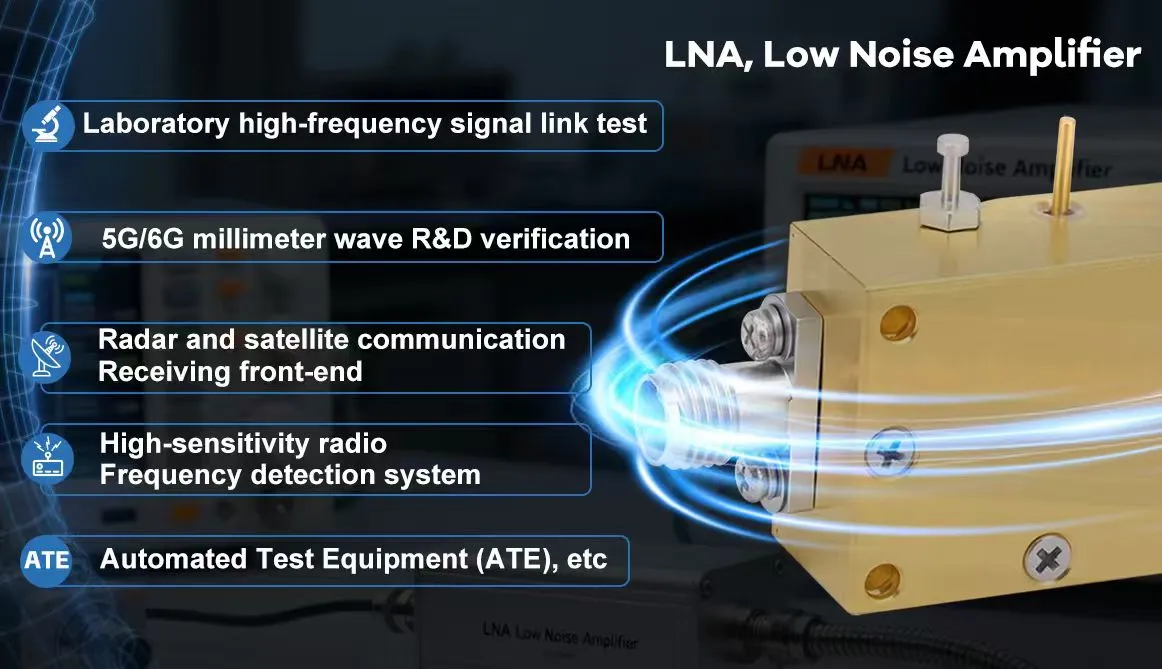
- Communication systems: satellite communication, mobile communication, satellite and terrestrial digital television;
- Radar and remote sensing systems: radar receiving ends, remote sensing and mapping;
- Test and measurement instruments: spectrum analyzers, signal analyzers;
- Aerospace and national defense: spacecraft payloads, electronic warfare systems.
Ⅳ: Flexi Rf Available amplifier
|
Product Model |
Interface Type |
Frequency Range |
Maximum Input VSWR |
Maximum Input VSWR |
Maximum Output VSWR |
Gain, Typical Value (dB)) |
P-1dB (dBm) |
Maximum Noise Figure (dB) |
DC Operating Voltage (V) |
Maximum Operating Current (mA) |
Maximum Output Power (dBm) |
|
GWLNA08040-45 |
2.92mm-female |
18-40GHz |
1.8 |
2.2 |
45 |
±3.5 |
15 |
3.5 |
+12 |
150 |
5 |
|
GWLNA018040-30 |
2.92mm-female |
18-40GHz |
1.8 |
2.2 |
30 |
±2.5 |
15 |
3.5 |
+12 |
120 |
5 |
|
GWLNA018040-15 |
2.92mm-female |
18-40GHz |
1.8 |
2.2 |
15 |
±2.5 |
15 |
3.5 |
+12 |
120 |
0 |
|
GWLNA008018-50 |
SMA-female |
0.8-18GHz |
1.8 |
2.2 |
50 |
±2.5 |
13 |
2.5 |
+12 |
150 |
0 |
|
GWLNA008018-40 |
SMA-female |
0.8-18GHz |
1.8 |
2.2 |
40 |
±2.0 |
13 |
3.0 |
+12 |
150 |
0 |
|
GWLNA008018-30 |
SMA-female |
0.8-18GHz |
1.8 |
2.2 |
30 |
±2.5 |
13 |
3.0 |
+12 |
120 |
5 |
|
GWLNA008018-20 |
SMA-female |
0.8-18GHz |
1.8 |
2.2 |
20 |
±2.5 |
13 |
3.0 |
+12 |
100 |
10 |
|
LNA-10M4G-G37-P20 |
SMA-female |
0.01-4GHz |
/ |
/ |
37 |
/ |
20 |
0.8 |
+5 |
90 |
0 |
|
LNA-10M4G-G17-P10 |
SMA-female |
0.01-4GHz |
/ |
/ |
17 |
/ |
10 |
0.8 |
+5 |
20 |
0 |
|
LNA-1M1500M-G40-P12 |
SMA-female |
0.001-1.5GHz |
/ |
/ |
40 |
/ |
12 |
2.4 |
+5 |
75 |
0 |