

Your Professional RF Amplifiers Supplier
Flexi RF Inc. was founded in 2023 in Santa Clara, California - at the heart of Silicon Valley, by a team of experienced RF engineers. We specialize in the design, manufacture, and supply of passive and active RF components. Our product line includes passive components such as antennas, connectors, adapters, cable assemblies, attenuators, and loads; and active components such as amplifiers, switches, and select custom modules.


Why Choose Us
OEM and ODM
We offer both OEM and ODM services with no minimum order quantity. Whether you are developing a next-generation system or require a mature RF module solution, we provide products and technical support that scale with your innovation.
Our Services
Flexi RF offers a one-year warranty on standard products, ensuring that our service remains reliable and efficient.
Real-Time Response
Our cross-border team, spanning China and the United States, can respond to customer needs around the clock, ensuring seamless and efficient service across time zones.
Professional Team
With decades of industry experience and professional R&D as well as manufacturing facilities, our team of experienced engineers possesses strong independent innovation capabilities, enabling us to provide customers with high-quality customized RF solutions.
Specification
|
Sku |
Connector-In |
Connector-out |
Frequency |
Gain |
VSWR |
Noise Figure, Max |
|
GWLNA008018-50 |
SMA Female |
SMA Female |
800MHz~18GHz |
50±2.5dB |
2.2 max |
3.0 |
|
P-1dB |
Voltage, DC Typ |
Voltage, DC Max |
Current, Max |
Max Input Power |
Body Material |
|
|
13dBm |
+12V |
+12V |
150mA |
-10dBm |
Brass Plating Nickel |
|
RF Amplifiers Advantages

Greater Gain (Better Sensitivity)
RF amplifiers provide significant gain, leading to improved sensitivity in RF receivers. This means they can detect and amplify weaker signals more effectively.

Enhanced Selectivity
RF amplifiers offer superior selectivity, allowing them to effectively isolate desired signals from a multitude of incoming signals at the RF receiver. They are good at filtering out unwanted noise and interference.
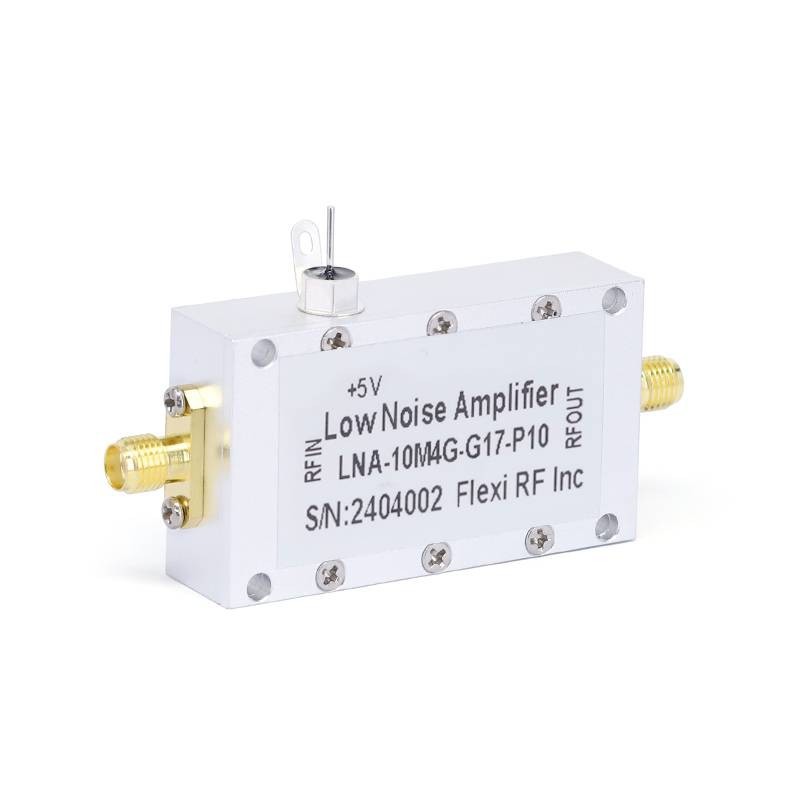
Amplification of Weak Signals
RF amplifiers are designed to boost the amplitude of weak received signals while preserving a good Signal-to-Noise Ratio (SNR). This is crucial for reliable communication in situations with low signal strength.
Types of RF Amplifiers
Low-Noise Amplifiers (LNAs) – RF amplifiers primarily used in communication systems to amplify weak signals captured by an antenna.
Broadband Amplifiers – RF amplifiers with a flat response over a wide range of frequencies.
RF Power Amplifiers – RF amplifiers that convert a low-power radio frequency signal into a larger signal for driving the antenna of a transmitter. They are used in a wide variety of applications, including wireless communication, TV Transmissions, Radar, and RF heating.
Solid-State Microwave Amplifiers – RF amplifiers for applications where extensive bandwidth and high gain are necessary.
RF & Microwave Amplifiers – Amplifier used for high-power amplification at low microwave frequencies.
Transistors: RF transistors, particularly those specialized for high-frequency operation (e.g., RF FETs or RF BJTs), are the preferred selection.
Inductors: For purposes of impedance harmonization and the creation of resonant circuits, inductors assume their role. They manifest as either wire-wound coils or chip inductors.
Capacitors: Capacitors, within RF circuits, undertake responsibilities such as tuning, coupling, and filtration.
Resistors: These components set the conditions governing transistor biasing and might see application within matching networks.
Impedance Matching Networks
Networks dedicated to impedance matching ensure concordance between the amplifier's input and output impedances with the source and load impedances, respectively.
Biasing Elements
Components of this nature (e.g., bias resistors, voltage sources) dictate the operational parameters governing transistor functionality.
RF Chokes
Deployed for the filtration and segregation of RF signals from DC biasing, RF chokes serve a discernible purpose.
Application of RF Amplifiers
Wireless Communication Systems: RF amplifiers constitute a foundational element within wireless communication infrastructures, encompassing:
● Cellular Telephony: Enabling signal enhancement for voice and data transmission.
● Wi-Fi Networking: Elevating signals to facilitate wireless internet connectivity.
● Satellite Communication: Amplifying signals for extended-distance satellite-based exchanges.
Broadcasting: Broadcasting mechanisms, whether in radio or television, enlist RF amplifiers to magnify signals before dissemination, catering to an extensive viewership.
Radar Installations: Radar systems hinge significantly on RF amplifiers for signal propagation and reception, an imperative for detecting and tracing entities like aircraft, vessels, and meteorological phenomena.
Medical Instrumentation: Medical equipment, such as MRI apparatus and RF ablation systems, harness RF amplifiers for the generation and augmentation of RF signals essential in medical procedures.
Scientific Apparatus: RF amplifiers play a pivotal role in scientific exploration and experimentation, making appearances in particle accelerators and instruments devoted to spectroscopy.
Aerospace and Defense: RF amplifiers assume a presence in aerospace and defense landscapes, underpinning military communication grids, radar configurations, electronic warfare contrivances, and secure, long-distance satellite communication.
Customization Services
To better meet the diverse needs of different industries and customers, we can tailor RF amplifiers professional solutions to your specific application scenarios and special requirements. For further information or support, please feel free to contact us.
Order Process
Contact Customer Service
1
>>
Submit Order
2
>>
Obtain a Quote
3
>>
Confirm Order
4
>>
Arrange Payment
5
>>
Track Order
6
>>
Receive and Inspect Goods
7
Packaging and Shipping
|
Packaging |
Plastic bags, paper boxes |
|
Transportation methods |
Road transport, rail transport, sea transport, air transport |
FAQ
We're professional low noise amplifiers manufacturers and suppliers in USA, specialized in providing high quality customized service. We warmly welcome you to buy high-grade low noise amplifiers in stock here from our factory.