
Your Professional DC Blocks Supplier
Flexi RF Inc. was founded in 2023 in Santa Clara, California - at the heart of Silicon Valley, by a team of experienced RF engineers. We specialize in the design, manufacture, and supply of passive and active RF components. Our product line includes passive components such as antennas, connectors, adapters, cable assemblies, attenuators, and loads; and active components such as amplifiers, switches, and select custom modules.

Why Choose Us
OEM and ODM
We offer both OEM and ODM services with no minimum order quantity. Whether you are developing a next-generation system or require a mature RF module solution, we provide products and technical support that scale with your innovation.
Our Services
Flexi RF offers a one-year warranty on standard products, ensuring that our service remains reliable and efficient.
Real-Time Response
Our cross-border team, spanning China and the United States, can respond to customer needs around the clock, ensuring seamless and efficient service across time zones.
Professional Team
With decades of industry experience and professional R&D as well as manufacturing facilities, our team of experienced engineers possesses strong independent innovation capabilities, enabling us to provide customers with high-quality customized RF solutions.
Specification
|
Sku |
Connector Series |
Frequency |
VSWR |
Insertion Loss |
|
FR5-GDCB-18G-SMAS-50 |
SMA Female |
10MHz~18GHz |
1.35 |
0.7dB |
|
Voltage, DC Max (Volts) |
Power, Max Input (Watts) |
Block Type |
Body Material |
Body Plating |
|
+50 |
2 |
Inner Block |
Stainless Steel |
Passivated |
Key Characteristics of DC Blocks
Maximum Voltage and Power Considerations
One primary characteristic to watch out for is the maximum voltage allowed by the DC block. The presence of RF signals introduces power considerations. It is imperative to assess the maximum power capacity of the DC block, as the cumulative power of both the DC and AC components may surpass the specified threshold.
Frequency Range for AC Signals
Another critical aspect is the frequency range of AC signals that the DC block permits. Different applications may require specific frequency ranges, and ensuring compatibility is essential for effective signal isolation. The DC block acts as a gatekeeper, allowing only designated frequencies to pass while blocking unwanted components.
Insertion Loss Evaluation
Assessing the insertion loss of the DC block is vital for gauging its impact on signal strength. Insertion loss quantifies the reduction in signal power as it passes through the component. Minimizing insertion loss is crucial, especially in applications where signal strength is a critical factor.
VSWR (Voltage Standing Wave Ratio)
VSWR, or reflection coefficient, is crucial for evaluating the impedance match between the DC block and the connected RF section. A well-matched system minimizes signal reflection and ensures efficient signal transmission.

A DC block works by using a capacitor to block DC voltage while allowing AC voltage to pass through. Capacitors are electronic components that store energy in an electric field. When a DC voltage is applied to a capacitor, it charges up and blocks any further flow of DC current. However, AC voltage is constantly changing direction, so the capacitor is able to pass it through.
In an RF system, a DC block is typically placed in series with the signal path. This means that the signal passes through the DC block before reaching the next component in the system. The capacitor in the DC block acts as a barrier to any DC voltage that might be present in the signal, while allowing the AC signal to pass through unimpeded.
Types of DC Blocks
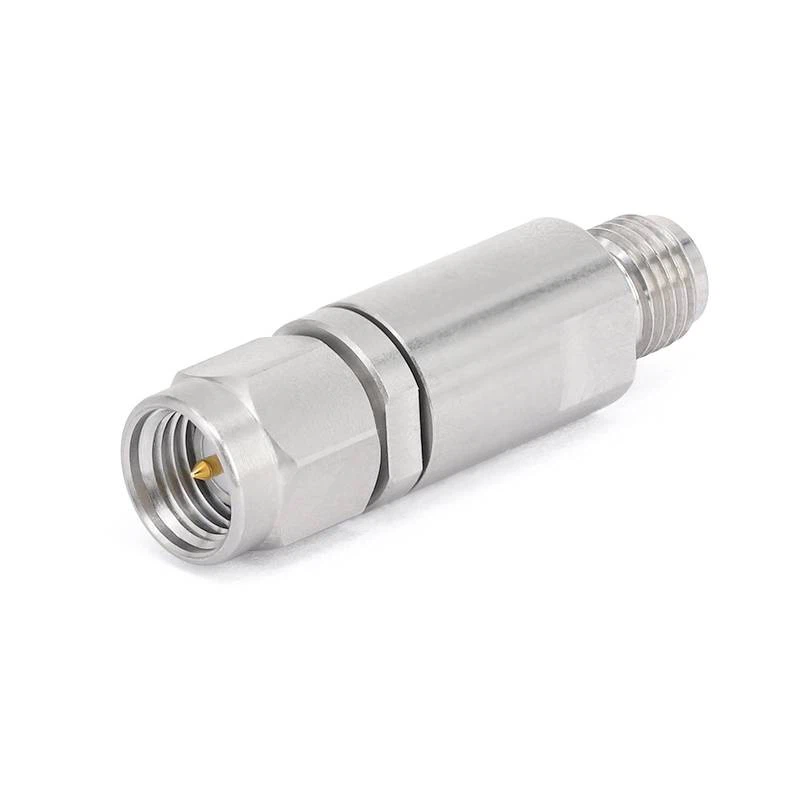
Inner DC Blocks
Inner DC blocks have a capacitor that is placed in series with the center conductor. They prevent the flow of DC and minimize the flow of low-frequency audio currents while providing minimum impedance to RF signals.
Outer DC Blocks
Outer DC blocks have a capacitor that is placed in series with the outer conductor. They prevent the flow of direct current and low-frequency current surges along the outer conductors of transmission lines.
Inner/Outer DC Blocks
Inner/Outer DC blocks have a capacitor placed in series with both the outer conductor and inner conductor. This prevents DC from passing along both conductors, typically in a coaxial connection.
● Protecting the input of a balanced mixer. When down converting RF signals in a direct conversion receiver architecture. Which can generate dangerously-high DC levels.
● Improving RF power measurements when a power sensor that is sensitive to DC signals is used.
● Protection from higher levels of DC voltage than the component is rated for.
● Improving the signal-to-noise ratio by filtering out low-frequency content.
Customization Services
To better meet the diverse needs of different industries and customers, we can tailor DC blocks professional solutions to your specific application scenarios and special requirements. For further information or support, please feel free to contact us.
Order Process
Contact Customer Service
1
>>
Submit Order
2
>>
Obtain a Quote
3
>>
Confirm Order
4
>>
Arrange Payment
5
>>
Track Order
6
>>
Receive and Inspect Goods
7
Packaging and Shipping
|
Packaging |
Plastic bags, paper boxes |
|
Transportation methods |
Road transport, rail transport, sea transport, air transport |
FAQ
We're professional dc blocks manufacturers and suppliers in USA, specialized in providing high quality customized service. We warmly welcome you to buy high-grade dc blocks in stock here from our factory.
dc pulling blocks, low frequency dc block, coax dc block