PCB board structure
Leave a message
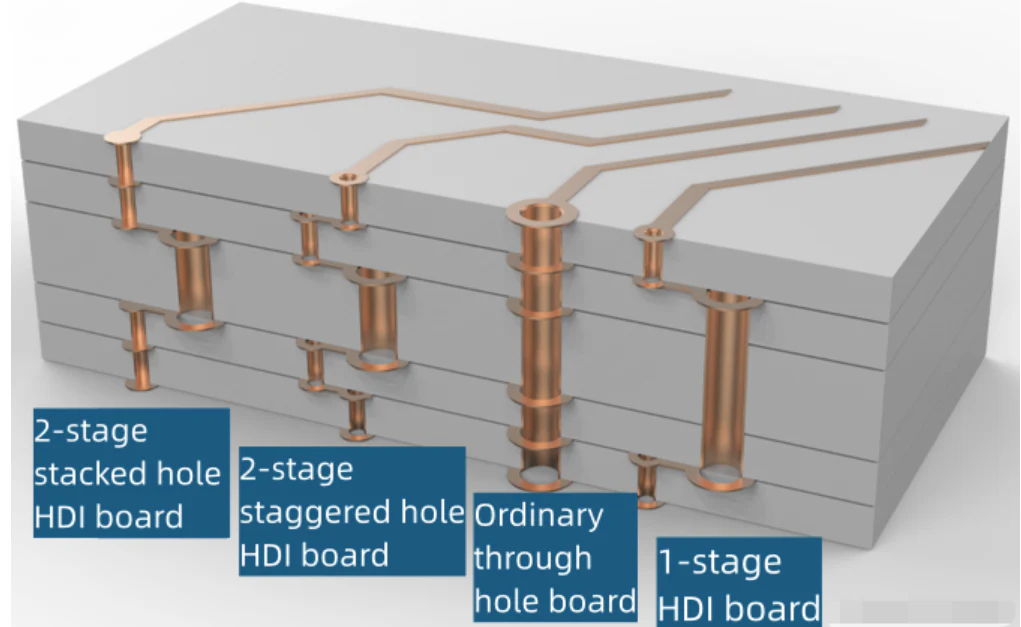
The structure of a PCB board mainly includes various board layer structures such as single-layer boards, double-layer boards, and multi-layer boards. The following is a detailed structural analysis:
1.Single-layer board
Structural composition: There is copper foil on only one side, and no copper foil on the other side. Components are usually placed on the side without copper foil, and the side with copper foil is mainly used for wiring and soldering.
Application scenarios: Suitable for simple circuits, such as electronic clocks, toys, etc. Its production process is simple and the cost is low, but its functions are relatively single.
2.Double-layer board
Substrate material: The commonly used one is FR-4, which is a mixture of glass fiber and epoxy resin. It has good mechanical strength, insulation, and heat resistance, and can provide stable support for the circuit board.
Conductive layer: That is, copper foil, which is distributed on the upper and lower sides of the substrate. Various circuit patterns are formed through the etching process for current transmission. The thickness of the copper foil can be selected according to requirements. For example, 1 ounce (oz) copper foil is suitable for large currents, and 1/2 ounce copper foil is suitable for ordinary circuits.
Insulating material: PP (prepreg) is used as the insulating material in the middle of the double-layer board. It is a mixture of semi-cured resin and glass fiber, which can firmly bond the two layers together and ensure that there is no short circuit between the two layers.
Surface protection material: Including solder mask and silkscreen layer. The solder mask is generally green, red, or black ink, which is used to protect the copper foil from oxidation and rust, and prevent solder from flowing to unwanted places during soldering, with only the pads exposing copper; the silkscreen layer is usually white ink, used to print text or symbols such as component positions and models on the PCB board, facilitating assembly and maintenance.
Application scenarios: The production process is relatively simpler than that of multi-layer boards. It is suitable for medium-complexity circuits, such as audio equipment, TV sets, etc. Components can be arranged on both sides of the board, and the wiring space is relatively more abundant than that of single-layer boards.
3.Multi-layer board
Signal layer: Used for placing components and wiring, it is the main layer connecting various components, including the top layer (Top Layer), bottom layer (Bottom Layer), and multiple intermediate signal wiring layers. Its wiring design directly affects the performance and reliability of the entire PCB.
Power layer and ground layer: Usually located in the middle layer, used to provide stable power supply and grounding for the entire circuit board. For example, in a four-layer board, the middle layer 1 may serve as a "power supply dedicated channel", such as the +5V line for powering the entire board, or a copper sheet as the "ground" (Ground), and the middle layer 2 may be divided into another power layer or serve as the wiring layer for another group of signal lines.
Insulating layer: FR-4 or other insulating materials are used to separate the various conductive layers, prevent short circuits, and ensure the independence and stability of signals.
Vias: Including through holes, blind holes, and buried holes. Through holes run through the entire board and are used to connect circuits of different layers and mount traditional components; blind holes are used to connect the top layer and inner layers, usually for high-frequency signal transmission, which can reduce the path length and make signal transmission faster; buried holes are responsible for electrical connections between inner layers. In high-density boards, the combination of blind holes and buried holes can accommodate more lines while avoiding the board being too thick.
Surface treatment layer: Similar to the double-layer board, it has a solder mask and a silkscreen layer, which play the roles of protection and identification. In addition, some high-end multi-layer boards will also undergo surface gold plating and other treatments to improve conductivity and corrosion resistance.
Application scenarios: Suitable for high-density, high-speed, and high-frequency complex circuits, such as computer motherboards, mobile phone motherboards, etc. The number of layers can be increased to meet the performance requirements of the circuit.