

What are the key performance parameters of RF amplifiers?
Leave a message

RF amplifiers are crucial components in a wide range of wireless communication systems, radar systems, and other RF applications. As an RF amplifiers supplier, understanding the key performance parameters of RF amplifiers is essential for providing high - quality products and meeting the diverse needs of our customers. In this blog, we will explore the main performance parameters that define the characteristics and capabilities of RF amplifiers.
Gain
Gain is perhaps the most fundamental parameter of an RF amplifier. It represents the ratio of the output power to the input power of the amplifier. Gain is usually expressed in decibels (dB). A higher gain means that the amplifier can increase the power of the input signal more effectively. For example, if an amplifier has a gain of 20 dB, it means that the output power is 100 times greater than the input power (since (G(dB)=10\log_{10}(P_{out}/P_{in})), and when (G = 20) dB, (P_{out}/P_{in}=10^{20/10}=100)).
The gain of an RF amplifier is not constant across all frequencies. It typically has a frequency - dependent response, which is described by the gain - frequency curve. The bandwidth of the amplifier is the range of frequencies over which the gain remains within a specified value, usually within 3 dB of the maximum gain. A wide - bandwidth amplifier is desirable in applications where a large range of frequencies needs to be amplified, such as in broadband communication systems.
Noise Figure
Noise figure is another critical parameter for RF amplifiers, especially in applications where the signal - to - noise ratio (SNR) is of utmost importance. The noise figure of an amplifier is defined as the ratio of the input SNR to the output SNR. It quantifies how much the amplifier degrades the SNR of the input signal. A lower noise figure indicates that the amplifier adds less noise to the signal.
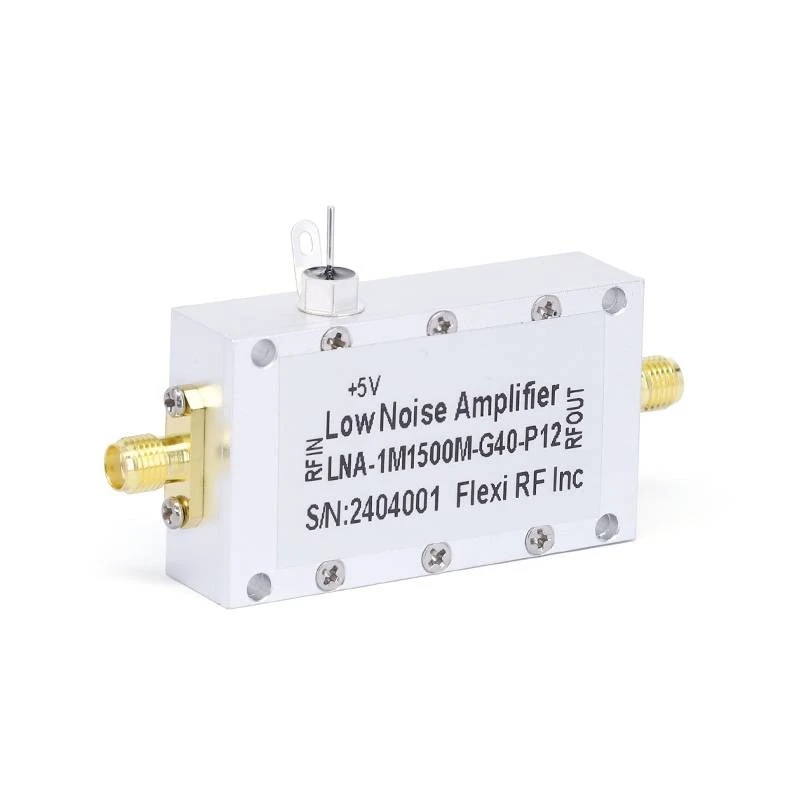
In many RF systems, such as receivers in wireless communication and radar systems, the front - end amplifier is often a Low Noise Amplifiers (LNA). LNAs are designed to have very low noise figures, typically in the range of 1 - 3 dB. By using an LNA at the front end, the overall noise performance of the system can be significantly improved, allowing for better detection and reception of weak signals.
Output Power
The output power of an RF amplifier is the power level that the amplifier can deliver to the load. There are several important output power specifications, including the saturation output power ((P_{sat})) and the 1 - dB compression point ((P_{1dB})).
The saturation output power is the maximum output power that the amplifier can produce. Beyond this point, increasing the input power will not result in a proportional increase in the output power, and the amplifier enters the saturation region where the gain starts to decrease significantly.
The 1 - dB compression point is the output power level at which the gain of the amplifier drops by 1 dB from its linear gain value. It is an important specification because it indicates the onset of non - linearity in the amplifier. In many applications, amplifiers are operated below the (P_{1dB}) to ensure linear operation and minimize distortion of the signal.

Linearity
Linearity is a measure of how well an amplifier can amplify a signal without introducing distortion. Non - linearity in an amplifier can cause intermodulation distortion (IMD), which results in the generation of additional frequency components that are not present in the original input signal. These unwanted frequency components can interfere with other signals in the system and degrade the overall performance.
Two important parameters for measuring linearity are the third - order intercept point (IP3) and the second - order intercept point (IP2). The IP3 is a theoretical point where the third - order intermodulation products intersect with the fundamental output power in a plot of output power versus input power. A higher IP3 value indicates better linearity and lower IMD. Similarly, the IP2 is related to the second - order intermodulation products.
Input and Output Impedance
The input and output impedance of an RF amplifier are important for proper matching with the source and the load, respectively. Impedance matching is crucial to ensure maximum power transfer between the amplifier and the connected components.
In most RF systems, the standard impedance is 50 ohms. An amplifier with an input impedance of 50 ohms can be easily connected to a 50 - ohm source, such as a transmission line or a signal generator, without significant reflection of the signal. Similarly, an output impedance of 50 ohms allows for efficient power transfer to a 50 - ohm load, such as an antenna or another RF component.
Power Added Efficiency (PAE)
Power added efficiency is a measure of how efficiently an RF amplifier converts DC power into RF output power. It is defined as the ratio of the RF output power minus the RF input power to the DC power consumed by the amplifier.
PAE is an important consideration, especially in battery - powered RF systems or in applications where power consumption needs to be minimized. High - efficiency amplifiers can reduce the overall power consumption of the system, extend the battery life, and also reduce the heat dissipation requirements. For example, in mobile communication devices, power amplifiers with high PAE are essential to improve the battery performance and reduce the thermal stress on the device.
Gain Flatness
Gain flatness refers to the variation in gain over a specified frequency band. An amplifier with good gain flatness has a relatively constant gain across the operating frequency range. This is important in applications where a uniform amplification of the signal is required, such as in broadband communication systems and test and measurement equipment.
The gain flatness is usually specified as the maximum deviation of the gain from its average value within the specified frequency band. For example, a gain flatness specification of ±0.5 dB means that the gain of the amplifier will not deviate more than 0.5 dB from its average gain value over the entire operating frequency range.
Phase Noise
Phase noise is a measure of the short - term frequency stability of an RF amplifier. It is caused by random fluctuations in the phase of the output signal. Phase noise can degrade the performance of RF systems, especially in applications such as frequency synthesis, radar, and communication systems that rely on accurate frequency and phase information.
In frequency - synthesizer applications, low phase noise is required to generate stable and pure frequency signals. High phase noise can result in spectral spreading of the signal, which can cause interference with other signals in the system and reduce the overall performance of the communication or radar system.
Isolation
Isolation is a parameter that measures the degree of electrical separation between different ports of an RF amplifier, such as the input and output ports. Good isolation between the input and output ports is important to prevent feedback and self - oscillation in the amplifier.
In multi - stage amplifiers or in amplifiers with multiple input and output ports, high isolation is required to ensure that the signals at different ports do not interfere with each other. Isolation is usually expressed in decibels, and a higher isolation value indicates better electrical separation between the ports.
Temperature Stability
The performance of RF amplifiers can be affected by temperature variations. Temperature stability is a measure of how well the amplifier maintains its performance parameters, such as gain, noise figure, and output power, over a wide temperature range.
In many applications, RF amplifiers are required to operate in harsh environmental conditions where the temperature can vary significantly. Amplifiers with good temperature stability are designed to compensate for the temperature - dependent changes in their performance, ensuring reliable operation over the entire temperature range.
Conclusion
As an RF amplifiers supplier, we understand the importance of these key performance parameters in meeting the diverse needs of our customers. By carefully designing and manufacturing amplifiers with optimized performance in terms of gain, noise figure, output power, linearity, and other parameters, we can provide high - quality RF amplifiers for a wide range of applications.
If you are in need of RF amplifiers for your project or application, we invite you to contact us for a detailed discussion. Our team of experts is ready to assist you in selecting the most suitable amplifier based on your specific requirements. Whether you need a low - noise amplifier for a receiver or a high - power amplifier for a transmitter, we have the expertise and the product portfolio to meet your needs.
References
- Pozar, D. M. (2011). Microwave Engineering. Wiley.
- Razavi, B. (2012). RF Microelectronics. Prentice Hall.
- Vendelin, G. D., Pavio, A. M., & Rohde, U. L. (1990). Microwave Circuit Design Using Linear and Nonlinear Techniques. Wiley.


