

What is the working principle of RF circulators?
Leave a message

In the realm of radio frequency (RF) technology, RF circulators play a pivotal role in managing the flow of RF signals. As a trusted supplier of RF circulators, I am excited to delve into the working principle of these remarkable devices, shedding light on their functionality and applications.
Understanding the Basics of RF Circulators
An RF circulator is a passive, non - reciprocal three - or more - port device. Non - reciprocity means that the behavior of the device depends on the direction of the signal flow. In contrast to reciprocal devices, where the transmission characteristics are the same in both directions, a circulator allows signals to flow in a specific, unidirectional manner around its ports.
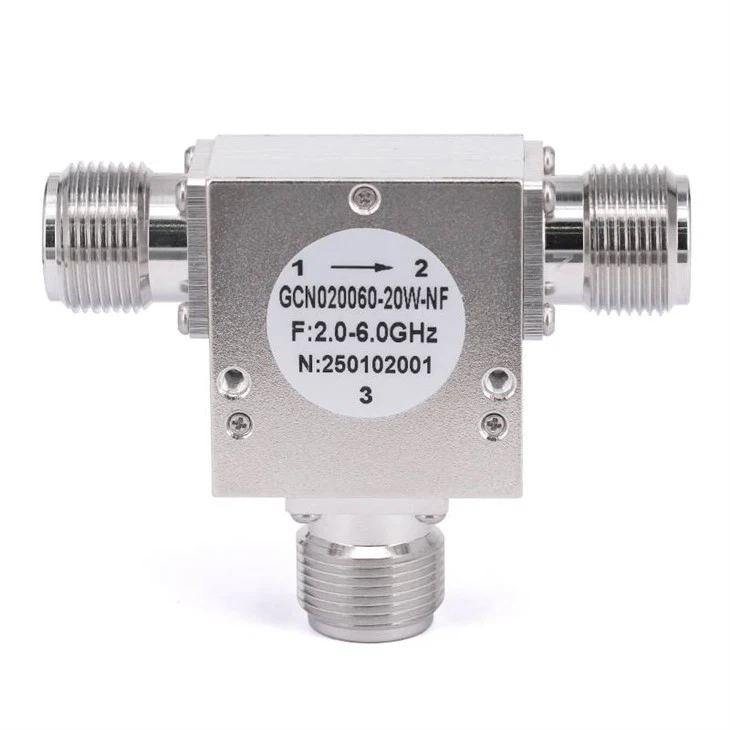
The most common type of RF circulator is the three - port circulator. In a three - port circulator, a signal entering port 1 will exit through port 2, a signal entering port 2 will exit through port 3, and a signal entering port 3 will exit through port 1. This unidirectional flow is crucial for many RF systems, as it enables efficient signal routing and isolation.
The Physical Structure of RF Circulators
To understand the working principle, it is essential to first look at the physical structure of an RF circulator. Most RF circulators are based on ferrite materials. Ferrite is a ceramic material with unique magnetic properties. It contains iron oxide along with other metal oxides, which give it its magnetic characteristics.
The ferrite material is placed in a magnetic field, typically generated by a permanent magnet. The magnetic field biases the ferrite, creating an anisotropic environment for the RF signals. The circulator also has a set of microstrip or stripline circuits that are coupled to the ferrite. These circuits are used to input and output the RF signals at the different ports.
The Working Principle: Faraday Rotation and Magnetic Anisotropy
The working principle of an RF circulator is based on two key phenomena: Faraday rotation and magnetic anisotropy.
Faraday Rotation
Faraday rotation is a magneto - optical effect where the polarization plane of an electromagnetic wave is rotated when it passes through a material in the presence of a magnetic field. In an RF circulator, the ferrite material acts as the medium for this rotation.
When an RF signal enters a port of the circulator, it interacts with the ferrite in the presence of the external magnetic field. The magnetic field causes the polarization of the RF signal to rotate as it propagates through the ferrite. The amount of rotation is proportional to the strength of the magnetic field and the length of the path through the ferrite.
Magnetic Anisotropy
Magnetic anisotropy refers to the property of a material where its magnetic properties depend on the direction. In the ferrite of an RF circulator, the magnetic anisotropy is carefully engineered. The external magnetic field aligns the magnetic domains in the ferrite in a particular direction, creating a preferred direction for the propagation of the RF signals.
The combination of Faraday rotation and magnetic anisotropy allows the circulator to direct the RF signals in a unidirectional manner. The design of the microstrip or stripline circuits in the circulator is optimized to take advantage of these effects. When a signal enters a port, the magnetic and electrical properties of the ferrite and the circuit cause the signal to be routed to the next port in the sequence.
Applications of RF Circulators
RF circulators are used in a wide range of applications due to their ability to isolate and route RF signals.
Radar Systems
In radar systems, circulators are used to separate the transmit and receive functions. The radar transmitter sends a high - power RF signal through port 1 of the circulator, which is then directed to the antenna through port 2. When the radar receives a reflected signal from a target, the signal enters the circulator through port 2 and is routed to the receiver through port 3. This separation ensures that the high - power transmit signal does not damage the sensitive receiver components.

Communication Systems
In communication systems, RF circulators are used for duplexing, which allows a single antenna to be used for both transmission and reception. They also help in isolating different parts of the system, reducing interference and improving the overall performance.
Test and Measurement Equipment
RF circulators are used in test and measurement equipment to route signals between different components. For example, they can be used to connect a signal source to a device under test and then route the output signal to a spectrum analyzer or other measurement instruments.
Our RF Circulator Offerings
As a leading supplier of RF circulators, we offer a wide range of high - quality products. Our RF Coaxial Circulators are designed to meet the diverse needs of our customers.
We use the latest manufacturing techniques and high - quality ferrite materials to ensure the reliability and performance of our circulators. Our products are available in different frequency ranges, power ratings, and form factors, making them suitable for a variety of applications.
Our engineering team has extensive experience in RF technology and can provide customized solutions for specific customer requirements. Whether you need a circulator for a small - scale research project or a large - scale industrial application, we have the expertise and resources to meet your needs.
Why Choose Our RF Circulators
Quality and Reliability
We adhere to strict quality control standards throughout the manufacturing process. Our circulators are tested rigorously to ensure that they meet or exceed industry standards. This ensures that our products have a long service life and reliable performance in demanding environments.
Technical Support
Our technical support team is always available to assist you with any questions or issues you may have. We can provide detailed technical specifications, application notes, and installation guidance to help you get the most out of our products.
Competitive Pricing
We understand the importance of cost - effectiveness in today's market. We offer our RF circulators at competitive prices without compromising on quality. This makes our products an attractive option for both large - scale manufacturers and small - to - medium - sized businesses.
Contact Us for Your RF Circulator Needs
If you are in the market for high - quality RF circulators, we invite you to contact us. Our sales team is ready to discuss your requirements and provide you with a customized solution. Whether you need a standard product or a custom - designed circulator, we have the capabilities to meet your expectations.
Let us be your trusted partner in RF technology. Contact us today to start the conversation about your RF circulator needs and explore the possibilities of working together.
References
- Pozar, D. M. (2011). Microwave Engineering. Wiley.
- Collin, R. E. (2001). Foundations for Microwave Engineering. Wiley - Interscience.
- Matthaei, G. L., Young, L., & Jones, E. M. T. (1964). Microwave Filters, Impedance - Matching Networks, and Coupling Structures. McGraw - Hill.


