Why Do 0 dB Attenuators Exist?
Leave a message
Many RF engineers may not even be aware of the existence of 0dB attenuators. At first glance, 0dB attenuators can seem counterintuitive-after all, their name suggests that their primary function is to reduce signal strength, yet they actually introduce no attenuation. However, their existence stems from practical engineering needs beyond simple signal attenuation. Here is a detailed breakdown of their main uses:
1. Impedance Matching
One of the most critical roles of 0dB attenuators is to ensure impedance consistency in electronic and radio frequency (RF) systems.
Many electronic systems (such as RF transmitters, antennas, and test equipment) are designed to operate with specific characteristic impedances (typically 50Ω or 75Ω). Impedance mismatches between connected components can cause signal reflections, which degrade signal integrity, reduce power transmission efficiency, and may even damage sensitive equipment. 0 dB attenuators are carefully engineered to maintain a precise, standardized impedance (e.g., 50Ω) at their input and output ports. When inserted between mismatched components, they "bridge" the impedance gap, minimizing reflections and ensuring efficient signal transmission without altering signal amplitude.
2. Mechanical/Interface Adaptation
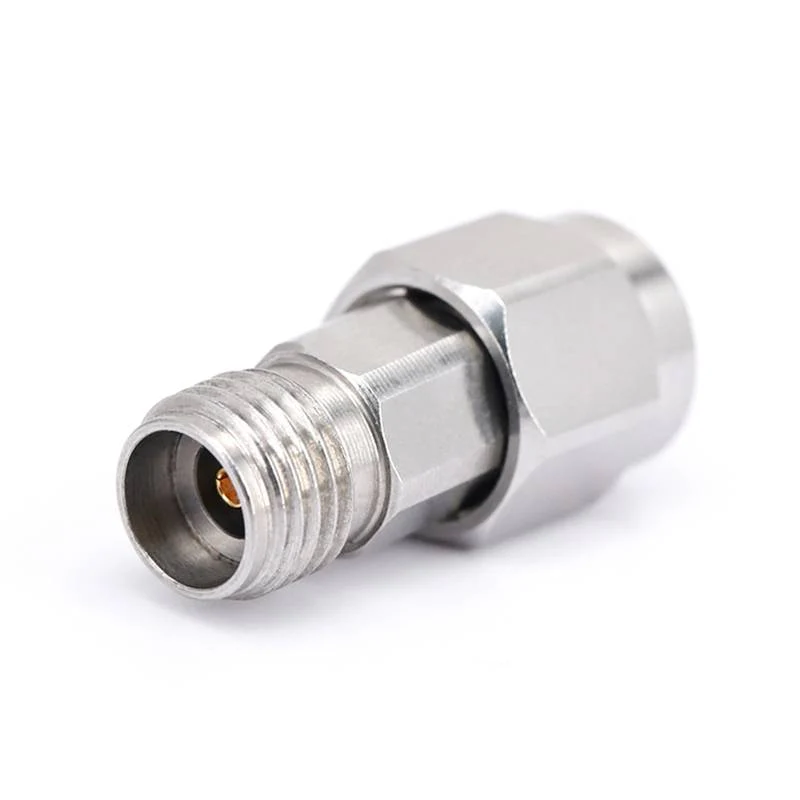
In complex systems, components often use different types of connectors (such as SMA, N-type, BNC) or physical forms. 0 dB attenuators are frequently used as adapters to resolve these incompatibilities.
3. Calibration and Testing Reference
In RF, microwave, and optical testing, precision is crucial. 0 dB attenuators serve as valuable calibration tools and reference points: they act as a "known standard" in test setups.
4. Signal Path Consistency
In systems where attenuation requirements change dynamically (such as communication networks or radar systems), 0 dB attenuators can maintain mechanical and electrical uniformity in the signal chain:
For example, a system may switch between using a 5 dB attenuator (to reduce strong signals) and requiring no attenuation (to handle weak signals). Inserting a 0 dB attenuator when no attenuation is needed ensures that the physical length, connector loading, and electromagnetic characteristics of the signal path remain exactly the same as when a higher-value attenuator is used, avoiding unexpected changes in signal phase, delay, or impedance that could interfere with system performance.
5. Isolation and Protection
Although they do not reduce signal amplitude, 0 dB attenuators are usually integrated with design features that provide electrical isolation or protection: they can buffer sensitive components (such as receivers) from voltage spikes or reflections generated by downstream devices (such as transmitters). Their internal circuitry (e.g., resistive networks) may dampen transient signals or prevent harmful reverse power from damaging upstream equipment. In high-frequency systems, even without attenuation, they can reduce "crosstalk" by isolating different sections of the signal path.
Application Examples
RF Communication Systems: A 0 dB attenuator between a transceiver and an antenna ensures 50Ω impedance matching, maximizing power transmission.
Test Labs: A 0 dB attenuator (SMA-to-BNC) is used to connect a signal generator and an oscilloscope, serving as both an interface adapter and a calibration reference.
Broadcasting: In video systems, 75Ω 0 dB attenuators match coaxial cables to amplifiers, preventing signal reflections that cause ghosting or distortion.
In conclusion, 0 dB attenuators are not "useless"-they are versatile components that solve key engineering challenges related to impedance, connectivity, calibration, and system stability, and their value extends far beyond signal attenuation itself.