

Understanding the Transition from Microwaves to Millimeter Waves in PCB Design
Leave a message
In the field of electronic engineering, the design of printed circuit boards (PCBs) faces numerous challenges and transformations as operating frequencies increase, and the transition from the microwave frequency band to the millimeter-wave frequency band represents a critical technological turning point.
Microwaves generally refer to electromagnetic waves with frequencies between 300MHz and 30GHz, widely used in communication (such as radar, satellite communication), navigation, and other fields. A relatively mature technical system has been formed for PCB design in this frequency band. For example, in transmission line design, there is extensive practical experience in controlling the characteristic impedance of structures like microstrip lines and striplines, and ensuring signal integrity.
Millimeter waves, on the other hand, are electromagnetic waves with frequencies ranging from 30GHz to 300GHz. In recent years, they have attracted significant attention due to emerging application demands such as 5G/6G communication, autonomous driving radar, and high-precision imaging. However, when transitioning to millimeter waves, PCB design needs to address a series of new issues:
1. Microstrip Line Technology
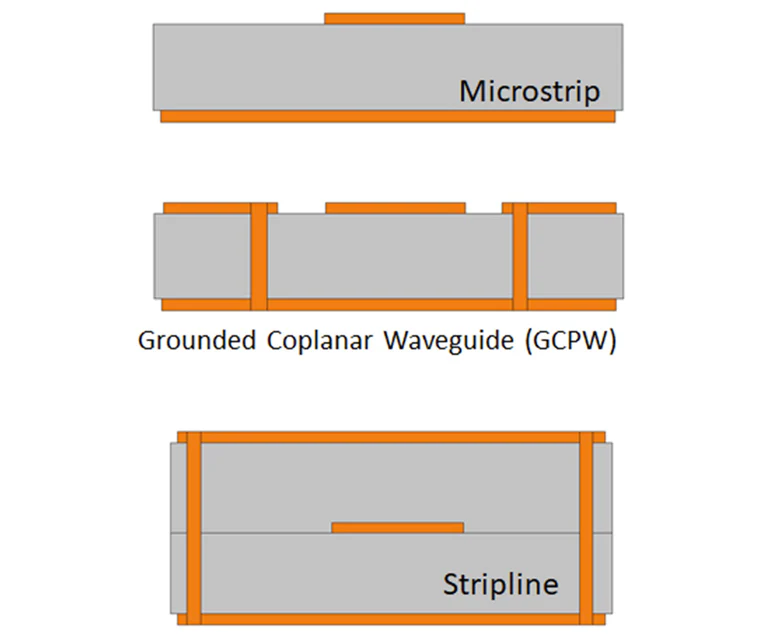
Microstrip line is one of the simplest and most commonly used transmission line technologies in microwave circuits, thanks to its ease of fabrication and high yield. Nevertheless, when transitioning to millimeter-wave frequencies, microstrip lines face numerous significant challenges. One key issue is radiation loss. At higher frequencies, microstrip circuits tend to behave like antennas, radiating energy into the surrounding air. This leads to unnecessary signal loss, which becomes more severe as the frequency increases. Additionally, the manufacturing of microstrip circuits requires extremely high precision, with strict tolerances for conductor width and copper thickness. As the frequency rises, the tolerance requirements become even stricter, and small deviations in the manufacturing process can cause serious performance problems.
Another challenge lies in the propagation characteristics of electromagnetic waves in microstrip circuits. Electromagnetic waves propagate not only through the circuit material but also through the surrounding air, which has a low dielectric constant. The low dielectric constant of air affects the effective dielectric constant of the entire circuit and must be taken into account when modeling the circuit. At millimeter-wave frequencies, circuit materials with a lower dielectric constant are usually preferred to reduce signal loss, but this may result in slower wave propagation and phase shifts.
2. Stripline Technology
Stripline is another reliable circuit technology capable of operating at millimeter-wave frequencies. It offers excellent isolation because the conductor is completely enclosed by dielectric material and ground planes. This design ensures that electromagnetic waves propagate entirely within the circuit material without interacting with the surrounding air. However, the problem with stripline is that it is difficult to launch signals into the circuit due to its enclosed structure.
Creating connectors for signal input and output becomes more challenging, especially at millimeter-wave frequencies. Moreover, this technology is highly sensitive to variations in the manufacturing process, making it difficult to achieve the required tolerances. For these reasons, stripline is less commonly used in millimeter-wave circuits, except for specific applications such as automotive radar systems.
3. Substrate Integrated Waveguide (SIW)
Substrate Integrated Waveguide (SIW) technology is gaining increasing popularity in millimeter-wave applications, particularly in automotive radar and other communication systems. SIW combines the advantages of waveguide technology and printed circuit board (PCB) fabrication. It forms a compact rectangular waveguide using a top metal layer, a bottom ground plane, and rows of plated through-holes (PTHs). This design enables low-loss signal propagation even at high frequencies.
However, the manufacturing of SIW circuits requires extremely high precision. The PTHs must be placed within very tight tolerances, especially for higher frequencies, making the fabrication process quite challenging. Additionally, SIW requires materials with minimal variations in dielectric constant, which further increases manufacturing difficulties.
4. Grounded Coplanar Waveguide (GCPW)
Grounded Coplanar Waveguide (GCPW) is another promising transmission line technology for millimeter-wave circuits. The GCPW structure combines dielectric materials and copper conductors to achieve low-loss signal propagation. It is particularly suitable for broadband RF, microwave, and millimeter-wave applications, such as test and measurement systems. GCPW can also be used in integrated designs where both millimeter-wave and lower-frequency circuits are required on the same PCB.
But GCPW circuits are sensitive to variations in the manufacturing process, such as changes in the dielectric constant of the dielectric material, substrate thickness, and copper surface roughness. These factors may cause phase distortion, which becomes more critical at millimeter-wave frequencies. To ensure optimal performance, strict control over the manufacturing process is necessary, including maintaining precise conductor width and thickness.
Key Considerations in Millimeter-Wave Circuit Design
As millimeter-wave circuit applications such as automotive radar and 5G wireless networks continue to grow, designers must consider several key factors when selecting circuit materials and transmission line technologies:
Manufacturing Tolerances:
Millimeter-wave circuits have extremely high tolerance requirements for conductor width, dielectric layer thickness, and copper surface quality.
Signal Integrity: It is necessary to minimize the impact of factors such as radiation loss, phase distortion, and changes in the dielectric constant of materials to ensure reliable performance at high frequencies.
Material Selection: The choice of PCB materials is crucial for the performance of millimeter-wave circuits. Materials with a low dielectric constant are preferred to reduce signal loss, but their properties must remain stable at high frequencies.
Conclusion
The design of millimeter-wave frequency circuits faces unique challenges, but at the same time, it brings enormous opportunities for emerging applications such as 5G networks and Advanced Driver Assistance Systems (ADAS). Understanding the advantages and limitations of different transmission line technologies such as microstrip lines, striplines, SIW, and GCPW is crucial for making informed decisions in the transition from microwave to millimeter-wave design.


