
How to select an RF amplifier for a specific frequency band?
Leave a message

Selecting an RF amplifier for a specific frequency band is a critical decision in many RF and microwave applications. As an RF amplifiers supplier, I understand the complexities involved in this process and am here to guide you through the key considerations to ensure you make the right choice.
Understanding the Frequency Band Requirements
The first step in selecting an RF amplifier is to clearly define the frequency band of your application. Different applications operate at different frequency ranges, such as cellular communication, Wi-Fi, satellite communication, and radar systems. Each frequency band has its own characteristics and requirements.
For example, in cellular communication, the frequency bands can range from 800 MHz to 2.6 GHz. Wi-Fi operates in the 2.4 GHz and 5 GHz bands. Satellite communication can cover a wide range of frequencies from L-band (1 - 2 GHz) to Ka-band (26.5 - 40 GHz). Radar systems can operate at frequencies from UHF (300 MHz - 3 GHz) to millimeter - wave frequencies.
It is essential to know the exact frequency range your amplifier needs to cover. This includes the lower and upper frequency limits, as well as any specific sub - bands within the overall range. Some amplifiers are designed to operate over a wide frequency range (broadband amplifiers), while others are optimized for a narrow frequency band (narrowband amplifiers).
Gain Requirements
Gain is another crucial parameter when selecting an RF amplifier. Gain is defined as the ratio of the output power to the input power of the amplifier, usually expressed in decibels (dB). The gain requirement depends on the specific application.
In a receiver system, a low - noise amplifier (LNA) is often used at the front - end to boost the weak incoming signal. The gain of an LNA typically ranges from 10 dB to 30 dB. In a transmitter system, a power amplifier is used to increase the power of the signal before transmission. Power amplifiers can have gains ranging from 10 dB to 60 dB or more, depending on the output power requirements.
When choosing an amplifier, make sure it can provide the required gain within the specified frequency band. Some amplifiers may have a flat gain response across the frequency band, while others may have a non - flat response. A flat gain response is often preferred in applications where a consistent amplification is required across the entire frequency range.
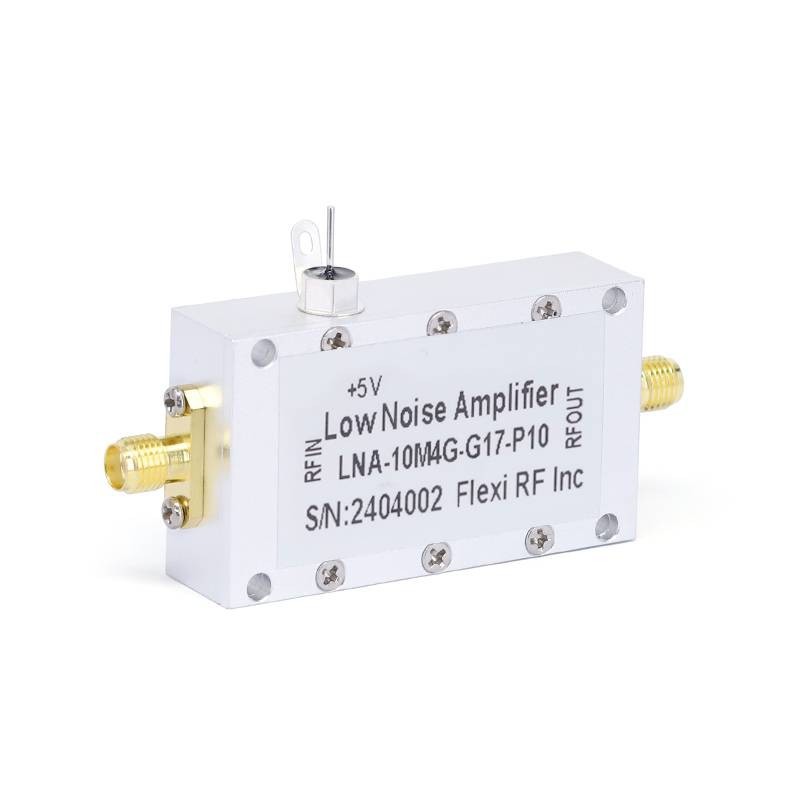
You can explore our Low Noise Amplifiers for more options suitable for receiver applications.
Noise Figure
The noise figure is an important parameter, especially for amplifiers used in receiver systems. It measures how much noise the amplifier adds to the input signal. A lower noise figure means that the amplifier adds less noise to the signal, resulting in a better signal - to - noise ratio (SNR) at the output.
The noise figure is expressed in decibels (dB). For low - noise amplifiers, the noise figure can be as low as 0.5 dB to 2 dB. In high - performance receiver systems, such as those used in satellite communication or radio astronomy, very low noise figures are required to detect weak signals.
When selecting an amplifier, consider the noise figure requirements of your application. A lower noise figure may come at a higher cost, so you need to balance the performance requirements with the budget.
Output Power
The output power of an amplifier is the power level at the output port. It is an important parameter for amplifiers used in transmitter systems. The output power requirement depends on the transmission distance, the type of antenna used, and the regulatory requirements.
Output power is usually expressed in watts (W) or dBm (decibels relative to 1 milliwatt). For example, in a Wi - Fi access point, the output power of the power amplifier may range from 100 mW (20 dBm) to 1 W (30 dBm). In a radar system, the output power of the power amplifier can be several kilowatts.
Make sure the amplifier can provide the required output power within the specified frequency band. Also, consider the power - added efficiency (PAE) of the amplifier. PAE is the ratio of the RF output power to the DC input power, and a higher PAE means less power consumption and less heat generation.
Linearity
Linearity is an important consideration, especially in applications where multiple signals are present or where the amplifier needs to handle large - amplitude signals. Non - linearities in an amplifier can cause intermodulation distortion (IMD), which can generate unwanted signals at frequencies other than the original signals.
The third - order intercept point (IP3) is a common measure of the linearity of an amplifier. A higher IP3 value indicates better linearity. In applications such as wireless communication systems, where multiple channels are present, a high IP3 value is required to minimize IMD and ensure reliable communication.
When selecting an amplifier, check the IP3 specification to ensure it can meet the linearity requirements of your application.

Stability
Amplifier stability is crucial to ensure reliable operation. An unstable amplifier can oscillate, which can cause interference and damage to the amplifier and other components in the system.
There are two types of stability: unconditional stability and conditional stability. An unconditionally stable amplifier is stable for all load and source impedances. A conditionally stable amplifier is stable only under certain load and source impedance conditions.
When choosing an amplifier, look for amplifiers that are unconditionally stable or can be easily stabilized using external matching networks.
Input and Output Impedances
The input and output impedances of an amplifier are important for proper signal transfer between the amplifier and other components in the system. In most RF and microwave systems, the standard impedance is 50 ohms.
Make sure the input and output impedances of the amplifier match the impedance of the source and load. Mismatched impedances can cause signal reflections, which can lead to reduced power transfer and increased VSWR (voltage standing wave ratio).
Cost and Availability
Cost is always a consideration when selecting an RF amplifier. High - performance amplifiers with low noise figures, high gain, and high output power can be expensive. You need to balance the performance requirements with the budget.
Also, consider the availability of the amplifier. Some high - end amplifiers may have long lead times or may be in short supply. Make sure the amplifier you choose is readily available or can be obtained within a reasonable time frame for your project.
Conclusion
Selecting an RF amplifier for a specific frequency band requires careful consideration of multiple parameters, including frequency band, gain, noise figure, output power, linearity, stability, input and output impedances, cost, and availability. As an RF amplifiers supplier, we have a wide range of amplifiers to meet different application requirements.
If you are unsure about which amplifier is the best fit for your specific application, our technical support team is ready to assist you. We can provide detailed product information, performance data, and application support to help you make an informed decision. Contact us for a consultation and start the procurement process today.
References
- Pozar, D. M. (2011). Microwave Engineering. Wiley.
- Gonzalez, G. (1997). Microwave Transistor Amplifiers: Analysis and Design. Prentice Hall.
- Vendelin, G. D., Pavio, A. M., & Rohde, U. L. (1990). Microwave Circuit Design Using Linear and Nonlinear Techniques. Wiley.


