

What are the features of a high - isolation power divider?
Leave a message

Hey there! As a power dividers supplier, I've been diving deep into the world of these nifty devices, especially high - isolation power dividers. So, what exactly are the features of a high - isolation power divider? Let's break it down.
1. High Isolation: The Name Says It All
The most obvious and crucial feature of a high - isolation power divider is, well, its high isolation. Isolation refers to the degree of separation between the output ports. In simpler terms, it's how well the divider keeps the signals at one output port from interfering with the signals at other output ports.
Imagine you're at a party where everyone is having their own conversations. High isolation is like having soundproof booths for each conversation. Each person can talk freely without being disturbed by the noise from other conversations. In a power divider, this means that the signals at different output ports can operate independently, reducing cross - talk and interference.
This high isolation is super important in applications where multiple signals need to be processed simultaneously. For example, in a communication system, different channels might be carried on different output ports of a power divider. If the isolation is low, the signals from one channel can leak into another, causing distortion and reducing the overall performance of the system.
2. Low Insertion Loss
Insertion loss is another key feature to look out for in a high - isolation power divider. Insertion loss is the amount of power that is lost when a signal passes through the power divider. You can think of it as the "tax" that the divider takes from the signal as it moves from the input to the output.
A good high - isolation power divider will have low insertion loss. This means that most of the power from the input signal is transferred to the output ports, rather than being dissipated as heat or lost in other ways. Low insertion loss is essential for maintaining the strength and quality of the signals.
Let's say you're sending a weak signal through a power divider. If the insertion loss is high, the signal might become too weak at the output ports to be useful. But with low insertion loss, the signal retains its strength, allowing it to be further processed or transmitted effectively.
3. Wide Frequency Range
High - isolation power dividers often have a wide frequency range. This means that they can handle signals of different frequencies without significant degradation in performance.
In today's world, where communication systems operate at various frequencies, from radio frequencies to microwave frequencies, a power divider with a wide frequency range is a real asset. It can be used in multiple applications, reducing the need for different dividers for different frequency bands.
For instance, in a wireless communication network, signals might be transmitted at different frequencies depending on the type of service. A high - isolation power divider with a wide frequency range can be used to split these signals, making it a versatile component in the network.
4. Good Phase Balance
Phase balance is an important feature that is sometimes overlooked. Phase balance refers to the difference in phase between the signals at the output ports. In an ideal power divider, the signals at all output ports should have the same phase.
A high - isolation power divider with good phase balance ensures that the signals at the output ports are in sync. This is crucial in applications where the phase of the signals matters, such as in phased - array antennas. In a phased - array antenna, the phase of the signals at different elements determines the direction of the antenna beam. If the phase balance of the power divider is poor, the antenna beam might not be directed correctly, reducing the antenna's performance.
5. High Power Handling Capability
Many high - isolation power dividers are designed to handle high power levels. This is important in applications where high - power signals need to be split.
For example, in a radar system, high - power signals are transmitted to detect targets. A power divider with high power handling capability can split these high - power signals without getting damaged. It can also ensure that the signals are split evenly, maintaining the performance of the radar system.
6. Compact Size
In modern electronic systems, space is often at a premium. High - isolation power dividers are increasingly being designed to be compact in size.
A compact power divider takes up less space on a printed circuit board (PCB), allowing for more components to be integrated into the system. This is especially important in portable devices, where size and weight are critical factors.
Our Product Range
As a power dividers supplier, we offer a wide range of high - isolation power dividers to meet different customer needs. We have 6 - Way Power Dividers, 3 - Way Power Dividers, and 4 - Way Power Dividers.
Our 6 - Way Power Dividers are great for applications where you need to split a signal into six equal parts. They offer high isolation, low insertion loss, and a wide frequency range, making them suitable for a variety of communication and radar systems.
The 3 - Way Power Dividers are perfect for smaller systems where you only need to split a signal into three parts. They are compact in size and have excellent phase balance, ensuring that the signals at the output ports are in sync.
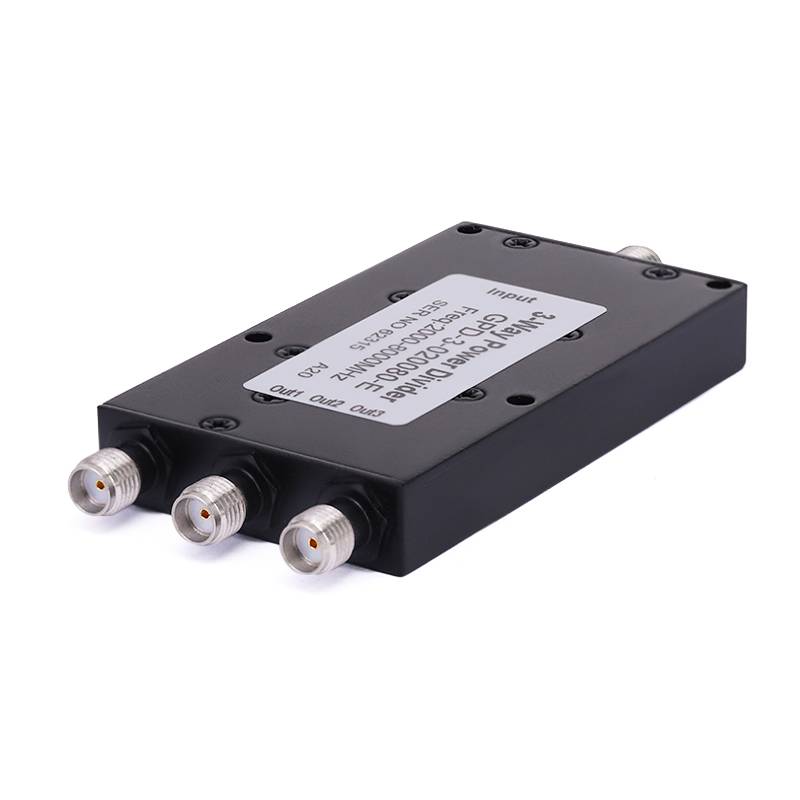

Our 4 - Way Power Dividers are a popular choice for many applications. They provide a good balance between the number of output ports and the performance of the divider. With high power handling capability and low insertion loss, they can handle a wide range of signals.
Why Choose Us?
When it comes to choosing a power divider supplier, there are a few things to consider. We pride ourselves on providing high - quality products at competitive prices. Our team of experts has years of experience in the field of power dividers, and we are constantly working on improving our products to meet the latest industry standards.
We also offer excellent customer service. Whether you have a question about our products or need help with a specific application, our team is always ready to assist you. We believe in building long - term relationships with our customers, and we are committed to providing the best possible solutions for your power divider needs.
Let's Talk!
If you're in the market for high - isolation power dividers, we'd love to hear from you. Whether you're a small business looking for a reliable power divider for your communication system or a large corporation in need of high - power handling dividers for your radar system, we have the products and expertise to meet your requirements.
Contact us today to start a conversation about your power divider needs. We're excited to work with you and help you find the perfect power divider for your application.
References
- Pozar, D. M. (2011). Microwave Engineering. Wiley.
- Collin, R. E. (2001). Foundations for Microwave Engineering. Wiley.


