

What is the cross - talk in RF circulators?
Leave a message

Hey there! As a supplier of RF circulators, I often get asked about various technical terms related to these nifty devices. One question that pops up quite a bit is, "What is the cross - talk in RF circulators?" Well, let's dive right in and break it down.
First off, let's understand what an RF circulator is. An RF circulator is a passive, non - reciprocal three - or four - port device. In simple terms, it allows RF signals to flow in a specific direction, usually in a circular pattern. For example, in a three - port circulator, a signal entering port 1 will exit through port 2, a signal entering port 2 will exit through port 3, and a signal entering port 3 will exit through port 1. This unidirectional flow is super useful in many RF systems, like radar and communication systems.

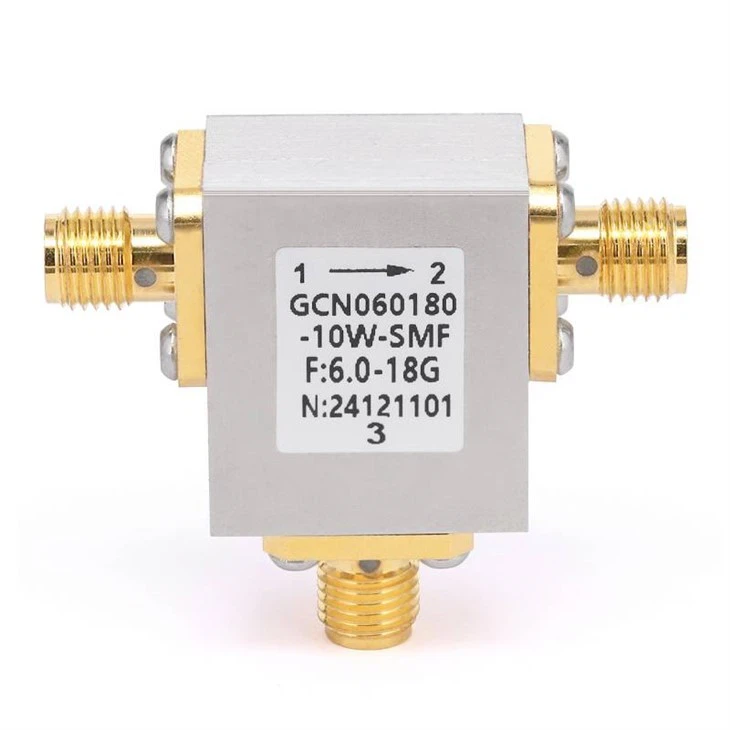
Now, what about cross - talk? Cross - talk in RF circulators refers to the unwanted coupling of signals between ports that are not supposed to be directly connected according to the circulator's normal operation. In an ideal world, a signal entering one port would only go to the next port in the circular sequence, and there would be zero signal leakage to other ports. But in reality, that's not the case.
There are a few reasons why cross - talk occurs. One major factor is the imperfect isolation between ports. Isolation is a measure of how well the circulator can prevent signals from leaking between non - adjacent ports. If the isolation is poor, then there's a higher chance of cross - talk. Another reason could be the presence of electromagnetic interference (EMI) within the device. EMI can cause signals to "jump" between ports, leading to cross - talk.
The performance of an RF circulator is often specified by parameters like insertion loss, isolation, and return loss. Cross - talk is closely related to isolation. A low isolation value means that there's more cross - talk. For instance, if a circulator has an isolation of 20 dB between port 1 and port 3, it means that the signal leaking from port 1 to port 3 is 20 dB weaker than the signal at port 1. A higher isolation value, say 30 dB or more, is generally better as it indicates less cross - talk.
Cross - talk can have a significant impact on the overall performance of an RF system. In communication systems, it can lead to interference between different channels, causing distortion and reduced signal quality. In radar systems, cross - talk can result in false echoes or inaccurate target detection. So, minimizing cross - talk is crucial for the proper functioning of these systems.
At our company, we understand the importance of low cross - talk in RF circulators. That's why we've put a lot of effort into improving the design and manufacturing processes of our circulators. We use high - quality materials and advanced technologies to enhance the isolation between ports and reduce the chances of cross - talk.
We offer a wide range of RF circulators to meet different customer needs. For example, our 18GHz RF Coaxial Circulators are designed for high - frequency applications. These circulators are built with precision to ensure low cross - talk and excellent performance at 18 GHz. They are suitable for use in satellite communication, wireless backhaul, and other high - speed RF systems.
Our 6GHz RF Coaxial Circulators are another popular choice. With a frequency range of up to 6 GHz, these circulators are ideal for applications like WiMAX, LTE, and other wireless communication systems. We've optimized the design of these circulators to minimize cross - talk and provide high isolation, ensuring reliable signal transmission.
If you're looking for even higher frequencies, our 26.5GHz RF Coaxial Circulators are the way to go. These circulators are engineered to handle the challenges of high - frequency operation, including reducing cross - talk. They are commonly used in millimeter - wave communication, radar, and test and measurement applications.
When choosing an RF circulator, it's important to consider the cross - talk specification along with other performance parameters. You need to make sure that the circulator can meet the requirements of your specific application. If you're not sure which circulator is right for you, our team of experts is always here to help. We can provide technical support and guidance to ensure that you get the best RF circulator for your needs.
In conclusion, cross - talk in RF circulators is an important factor that can affect the performance of RF systems. By understanding what causes cross - talk and how to minimize it, you can make more informed decisions when selecting RF circulators. At our company, we're committed to providing high - quality RF circulators with low cross - talk and excellent performance.
If you're interested in purchasing RF circulators or have any questions about cross - talk or our products, don't hesitate to reach out. We're eager to start a conversation and see how we can help you with your RF needs. Whether you're a small startup or a large corporation, we have the right solutions for you. Let's work together to build better RF systems!
References:
- "RF and Microwave Passive Components for Communication Systems" by Inder Bahl
- "Microwave Engineering" by David M. Pozar


