

How does RF travel?
Leave a message
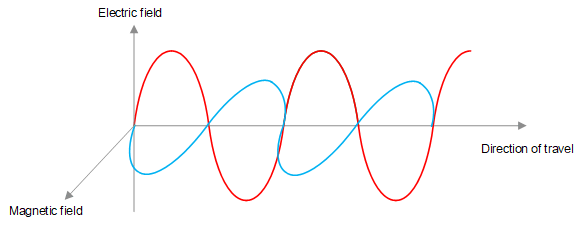
Radio Frequency (RF) waves are a type of electromagnetic radiation, and their propagation follows the fundamental principles of electromagnetic waves. Here is a detailed analysis of how RF waves propagate:
1. Nature of RF Waves
RF waves are part of the electromagnetic spectrum, with a frequency range of approximately 3 kilohertz (kHz) to 300 gigahertz (GHz). Like all electromagnetic waves, they consist of oscillating electric and magnetic fields, which are perpendicular to each other and both perpendicular to the direction of propagation.
2. Main Modes of RF Propagation
The propagation of RF waves depends on their frequency, environmental factors, and the distance between the transmitter and receiver. The main propagation modes include:
a. Line-of-Sight (LOS) Propagation
Principle: RF waves travel in straight lines, similar to visible light, requiring an unobstructed path between the transmitter and receiver.
Frequency range: Typically used for higher frequencies.
Examples: Satellite links, microwave towers, short-range Wi-Fi, and radar systems.
Limitation: Blocked by buildings, mountains, or the Earth's curvature. Therefore, long-distance LOS links usually rely on towers or satellites to achieve "mutual visibility."
b. Ground Wave Propagation
Principle: RF waves travel along the Earth's surface, guided by the ground and the lower atmosphere. The waves induce currents in the ground, causing them to slow down and bend (following the Earth's curvature).
Frequency range: Low frequencies (LF, 30–300 kHz) and medium frequencies (MF, 300 kHz–3 MHz), such as amplitude modulation (AM) radio (535–1605 kHz).
Advantage: Can propagate over long distances over land or water, with the ground providing a stable path.
Limitation: Subject to attenuation (weakening of energy) by the ground, especially over rough or highly conductive terrain (e.g., wetlands).
c. Sky Wave (Ionospheric) Propagation
Principle: RF waves are reflected or refracted by the ionosphere-a layer of charged particles (ions) in the Earth's upper atmosphere, located 60–1000 kilometers above the ground. The waves bounce between the ionosphere and the ground, enabling long-distance communication.
Frequency range: High frequencies (HF, 3–30 MHz), used for shortwave radio, amateur radio, and long-range aviation/maritime communication.
3. Factors Affecting Wave Propagation:
Transmission angle: A lower angle allows for longer "hops."
d. Diffraction
Principle: When encountering edges or apertures, RF waves bend around obstacles (such as buildings or hills). This enables signals to reach areas behind obstacles even without a direct line of sight.
e. Reflection
Principle: RF waves reflect off surfaces like buildings, water, metal objects, or the ground. Reflected waves can reach the receiver indirectly but may cause multipath interference (when direct and reflected waves are out of phase, weakening or distorting the signal).
f. Refraction
Principle: RF waves bend when passing through media of different densities (e.g., atmospheric layers with varying temperature, humidity, or ion density), which may cause upward or downward deflection.
4. Attenuation and Losses
RF waves lose energy (attenuation) during propagation due to the following reasons:
Free space path loss: The natural spreading of waves as they travel away from the transmitter (signal strength decreases with the square of the distance).
Absorption: Substances such as water vapor, rain, or foliage absorb RF energy.
Scattering: Waves are dispersed by small particles or rough surfaces, reducing signal strength.
Summary
RF waves propagate as electromagnetic radiation, and their propagation modes are determined by frequency and the environment: higher frequencies primarily use line-of-sight propagation, lower frequencies rely on ground waves, and high frequencies achieve sky wave propagation through ionospheric reflection. Additionally, there are auxiliary effects such as diffraction, reflection, and refraction. Understanding these modes is crucial for designing communication systems (e.g., cellular networks, radio, satellites) to ensure reliable transmission.


