

What's the differences between semi-rigid and semi-flexible cables?
Leave a message
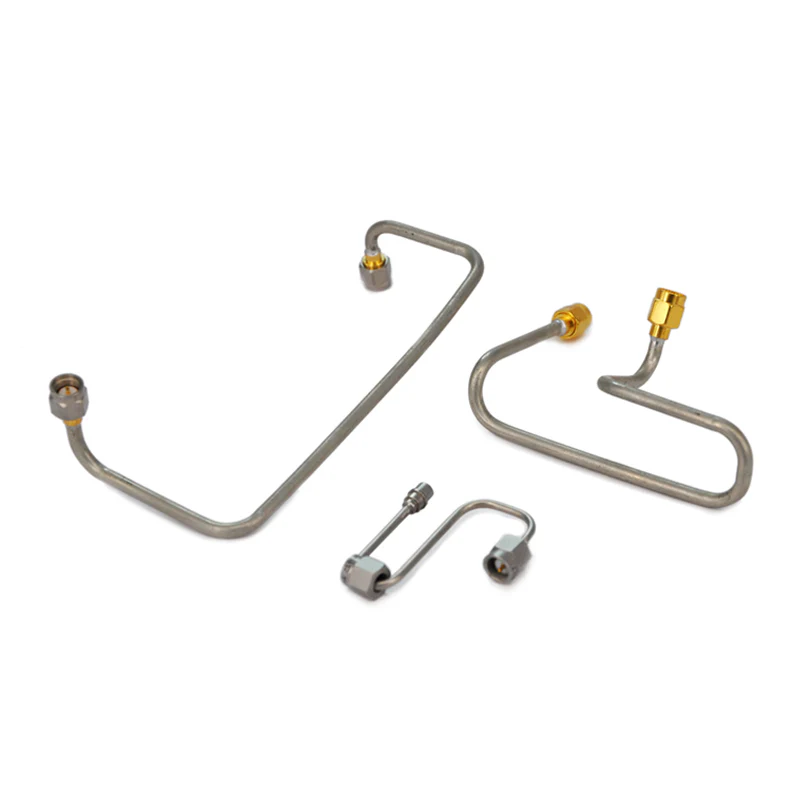
Comparison Between Semi-Rigid and Semi-Flexible Cables
Both semi-rigid and semi-flexible cables are widely used in high and low-frequency communication scenarios, but they differ significantly in structure, flexibility, performance, and application scenarios. Below is a detailed comparison:
1. Structural Design
Semi-Rigid Cables
The outer conductor is made of a solid, non-bendable material (usually copper) with a fixed diameter; the inner conductor is centrally supported by a dielectric material (e.g., PTFE).
Once formed, it maintains a fixed shape and cannot be easily bent or reshaped without specialized tools.
Semi-Flexible Cables
The outer conductor features a braided structure, with the entire braided layer tinned, making it more deformable than the solid outer conductor of semi-rigid cables. The inner conductor is also supported by a dielectric material, but the braided structure allows repeated bending and shaping by hand or simple tools.
2. Flexibility Comparison
Semi-Rigid Cables
They have high rigidity, retaining their shape after formation and exhibiting strong resistance to bending. Forcing bending without professional tools may damage the outer conductor, leading to performance degradation.
Semi-Flexible Cables
They offer moderate flexibility, allowing repeated bending, coiling, or routing around obstacles without permanent damage. Their flexibility lies between rigid and fully flexible cables.
3. Electrical Performance Parameters
| Parameter | Semi-Rigid Cables | Semi-Flexible Cables |
|---|---|---|
| Impedance Stability | Excellent - Fixed geometry ensures consistent impedance across all frequencies. | Good but inferior to semi-rigid - Braided outer conductors may cause slight impedance fluctuations at extremely high frequencies. |
| Loss | Low insertion loss, especially in microwave bands (up to 100+ GHz), due to the smooth surface of the solid outer conductor. | Higher insertion loss than semi-rigid, particularly at high frequencies, due to tiny gaps and surface irregularities in the braided outer conductor. |
| Shielding Effectiveness | Excellent (typically > 100 dB). The solid outer conductor effectively blocks EMI and RFI. | Good (typically 80 dB) but lower than semi-rigid. Gaps in the braided conductor may cause minor EMI leakage. |
| Power Handling Capacity | Higher - Solid conductors have efficient heat dissipation, suitable for high-power scenarios. | Lower - Poor thermal conductivity of braided conductors limits power capacity. |
4. Application Scenarios
Semi-Rigid Cables
Suitable for high-frequency, high-precision scenarios requiring strict stability and low loss, such as:
Aerospace and defense systems (radar, satellite communication);
Microwave test equipment (vector network analyzers, signal generators);
Medical devices (MRI machines, microwave therapy systems);
Permanent installations with fixed lengths (e.g., base station antenna feeders).
Semi-Flexible Cables
Suitable for scenarios needing moderate flexibility with good performance, such as:
Portable test setups (e.g., connections between instruments and DUTs);
Indoor RF systems (WiFi routers, cellular signal boosters);
Scenarios requiring occasional reconfiguration (e.g., laboratory prototype development);
Internal connections in RF switch matrices.
Summary
Semi-rigid cables excel in high-performance, fixed-installation scenarios, offering superior stability and low loss. Semi-flexible cables, on the other hand, are more advantageous in scenarios requiring moderate flexibility with good performance, balancing functionality and usability.
Supplementary Notes: Cost and Maintenance Differences
Semi-Rigid Cables:
Higher manufacturing costs due to the solid copper outer conductor and the need for specialized tools for formation. Installation and maintenance are more complex (requiring professional operators). However, their stable performance, resistance to aging, and wear result in lower long-term costs, making them suitable for scenarios with strict reliability requirements.
Semi-Flexible Cables:
Lower costs due to simpler production processes for braided outer conductors and no need for specialized forming tools. Additionally, their manual bendability reduces maintenance and reconfiguration costs, making them ideal for scenarios requiring frequent adjustments or with budget constraints.
Extension: Brief Comparison with Fully Flexible Cables
To better understand "semi-flexible" positioning, a brief comparison with fully flexible cables is useful:
Fully flexible cables have outer conductors typically braided from fine copper strands (with little or no tinning), offering extreme flexibility for bending or even knotting. However, their electrical performance (e.g., impedance stability, shielding effectiveness) is lower than semi-flexible cables, suiting short-distance, low-frequency applications with high flexibility needs (e.g., headphone wires, internal connections in small devices).
Semi-flexible cables strike a balance between flexibility and performance, filling the gap between semi-rigid (high performance but non-adjustable) and fully flexible (high flexibility but weaker performance) cables.


