

What's the difference between Yagi antennas and log-periodic antennas?
Leave a message
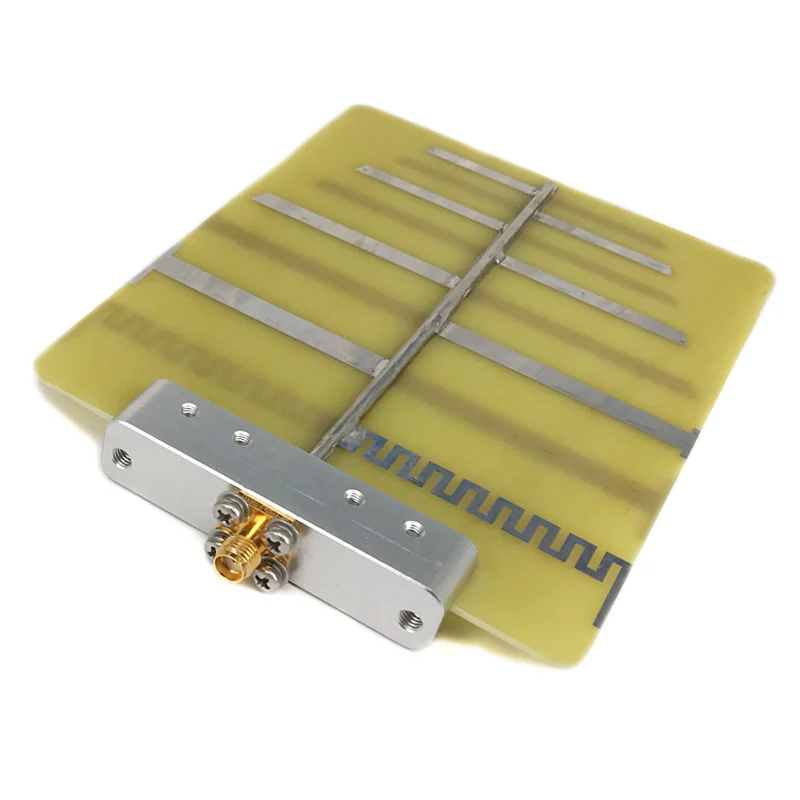
Yagi antennas (Yagi-Uda antennas) and log-periodic antennas are both directional, end-fire antennas, but they differ significantly in design, performance, and applications due to their distinct operating principles. Below is a detailed comparison across key dimensions:
1. Structural Design
Yagi Antennas
Consist of a driven element (the active radiator connected to the feedline), one reflector (longer than the driven element), and multiple directors (shorter than the driven element).
Elements are arranged in a straight line, with the reflector behind the driven element and directors in front.
Typically have a small number of elements (e.g., 1 reflector + 1 driven element + 3–10 directors), making the structure compact.
Log-Periodic Antennas
Composed of a series of dipole-like elements (振子) with gradually increasing lengths, arranged along a central boom or feedline.
Element lengths and spacing follow a log-periodic relationship: the ratio of consecutive element lengths and distances is constant (e.g., τ=lnln+1=dndn+1, where τ<1).
Requires more elements (often 10–30+) to achieve wide bandwidth, resulting in a longer, more complex structure.
2. Operating Principle
Yagi Antennas
Resonant design: Each element (reflector, driven element, directors) is tuned to a specific frequency (resonant at the target wavelength). The reflector and directors interact with the driven element to focus radiation in one direction (toward the directors).
Radiation is enhanced by constructive interference in the forward direction (toward directors) and destructive interference in the reverse direction (blocked by the reflector).
Log-Periodic Antennas
Non-resonant design: No single element is tuned to a specific frequency. Instead, at any given frequency, only a subset of elements (those whose length is ~λ/2 for that frequency) actively contribute to radiation.
The log-periodic ratio τ ensures that the antenna's performance repeats periodically on a logarithmic frequency scale, enabling consistent operation across a wide band.
3. Bandwidth
This is the most critical difference:
Yagi Antennas: Narrow bandwidth (typically 10–20% of the center frequency). Performance degrades rapidly outside this range because the resonant elements are only optimized for a specific wavelength.
Log-Periodic Antennas: Ultra-wide bandwidth (often covering multiple octaves, e.g., 1:10 or wider frequency ratios). They maintain stable performance across their entire band due to the log-periodic element arrangement, which adapts to different wavelengths.
4. Gain
Yagi Antennas: High gain within their narrow bandwidth (typically 5–15 dBi). Gain increases with the number of directors (more directors = higher gain, but narrower bandwidth).
Log-Periodic Antennas: Moderate but stable gain across their wide band (typically 3–10 dBi). Gain varies little with frequency, making them reliable for multi-band applications.
5. Directionality
Both are directional (end-fire) antennas, radiating most energy in one primary direction:
Yagi Antennas: Very sharp directivity with a narrow main lobe (low beamwidth) and low side lobes, making them highly focused.
Log-Periodic Antennas: Moderate directivity with a slightly wider main lobe than Yagis, but this beamwidth remains stable across their wide frequency range.
6. Applications
The key distinction in bandwidth drives their use cases:
Yagi Antennas: Ideal for narrowband, fixed-frequency applications where high gain and sharp directionality are prioritized, such as:
TV/radio broadcasting reception (e.g., UHF/VHF TV antennas).
Point-to-point communication (e.g., microwave links for rural internet).
Amateur radio (HF/VHF bands) and radar systems.
Log-Periodic Antennas: Preferred for wideband applications requiring coverage across multiple frequencies, such as:
Communication systems (military, emergency services) needing to operate on varying frequencies.
EMC (Electromagnetic Compatibility) testing (to detect interference across broad bands).
Shortwave to microwave receivers/transmitters (e.g., spectrum analyzers, radio astronomy).
Summary Table
| Characteristic | Yagi Antenna | Log-Periodic Antenna |
|---|---|---|
| Structure | Driven element + 1 reflector + few directors | Series of scaled dipoles (log-periodic ratio) |
| Bandwidth | Narrow (10–20% of center frequency) | Wide (multiple octaves, e.g., 1:10) |
| Gain | High (5–15 dBi) but frequency-dependent | Moderate (3–10 dBi) and stable across band |
| Directivity | Sharp (narrow main lobe, low side lobes) | Moderate (wider main lobe, stable over band) |
| Operating Principle | Resonant (tuned to specific wavelength) | Non-resonant (adapts to varying wavelengths) |
| Typical Applications | Fixed-frequency TV, point-to-point links | Wideband communication, EMC testing |
In short, Yagis excel in narrowband, high-gain scenarios, while log-periodic antennas are indispensable for wideband flexibility.


