

The differences between using a PIN diode to control voltage and using a D-Sub 9-pin interface to control an RF mechanical switch
Leave a message
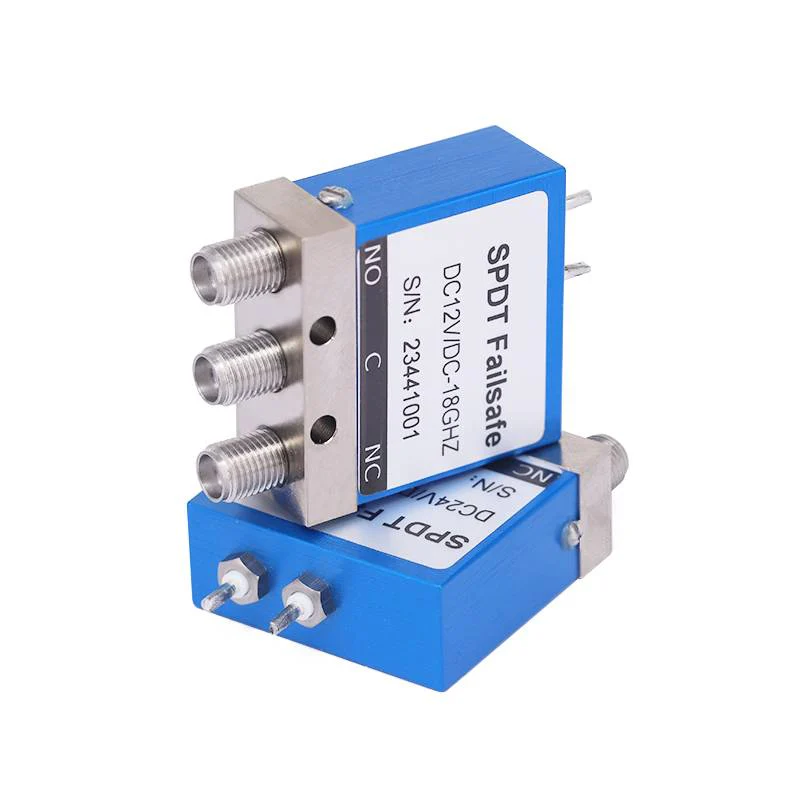
The differences between using a PIN diode for voltage control and using a D-Sub 9-pin interface to control an RF mechanical switch are reflected in multiple aspects, including working principles, performance indicators, and practical applications. Here is a detailed analysis:
1. Working Principles
PIN Diode Control:
A PIN diode is a semiconductor device with a P-I-N structure. It modulates the transmission of RF signals by changing the conductivity of the intrinsic (I) layer through a DC bias voltage.
Forward Bias: Reduces the resistance of the I layer, allowing RF signals to pass with minimal loss.
Reverse Bias: Expands the depletion region, blocking RF signals.
This electronic switch is a solid-state device, achieving switching speeds from nanoseconds to microseconds depending on voltage levels.
D-Sub 9-Pin + Mechanical Switch:
The D-Sub 9-pin interface (such as the DE-9 connector) typically transmits digital control signals (e.g., TTL logic) to drive the RF mechanical switch. The switch switches RF signal paths by physically moving contacts. It requires an external drive circuit (such as a relay or transistor) to convert low-power logic signals into mechanical motion.
2. Performance Indicators
Switching Speed
PIN diodes have a switching speed of nanoseconds to microseconds, suitable for high-frequency applications such as 5G and radar;
Due to physical movement, mechanical switches operate at a speed of milliseconds and are not suitable for rapid signal switching.
Insertion Loss and Isolation
PIN Diodes: The insertion loss is usually 0.5–2 dB in the on-state, depending on frequency and bias. The isolation is 20–60 dB in reverse bias but decreases at high frequencies. The nonlinearity of PIN diodes may generate harmonics, requiring careful design.
D-Sub 9-Pin + Mechanical Switches: The insertion loss is extremely low (0.1–1.5 dB) over a wide frequency band. The isolation is excellent (60–100 dB), which is crucial for high-power or sensitive receivers. There is no harmonic distortion due to purely mechanical operation.
3. Power Handling Capacity
PIN diodes can handle up to kilowatts of power in pulsed applications (such as radar) with proper thermal management, but their continuous-wave (CW) power is limited by self-heating.
Mechanical switches perform well in high-power continuous-wave scenarios (such as broadcast transmitters) with a rated power of up to tens of kilowatts.
4. Reliability and Lifespan
PIN Diodes:
They have no moving parts, can achieve more than 10^9 operations, and have strong vibration resistance.
They are susceptible to thermal stress, and their lifespan depends on the duty cycle and cooling conditions.
Mechanical Switches:
Their lifespan is limited (10^5–10^6 operations) due to contact wear.
They are sensitive to physical shocks and vibrations, which reduces their reliability in harsh environments.


