Differences and connections between RF Circulators and RF Isolators
Leave a message
Principle of Operation:
RF Circulator:
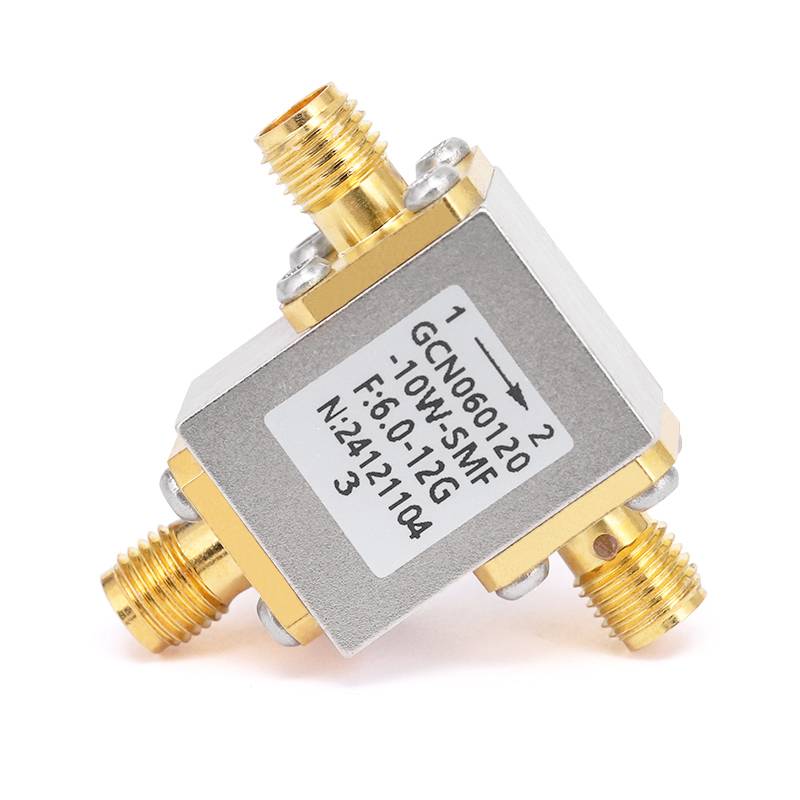
A circulator is a three-port (or more) device that directs RF signals in a specific direction between the ports. It ensures that signals flow from one port to the next in a defined direction.
The circulator works based on the nonlinear effects of magnetic materials. It typically consists of a rotating non-linear material coupled to a magnetic field. In a three-port circulator, the signal from Port 1 goes to Port 2, Port 2's signal goes to Port 3, and Port 3's signal is routed back to Port 1.
RF Isolator:
An isolator is typically a two-port device that allows the signal to flow from one port to another while blocking any signal from returning to the original source.
Similar to the circulator, an isolator uses magnetic materials for its operation, but it only has two ports. The isolator prevents reverse signal flow, isolating the source from any reflected signals that could cause damage or interference.
Key Operating Principle: Magnetic Materials
Both devices leverage ferromagnetic materials (e.g., ferrite) under a static magnetic field. The magnetic field induces non-reciprocal propagation of RF signals, meaning signal behavior differs when traveling forward vs. backward. This non-reciprocity enables:
Circulators to route signals sequentially between ports.
Isolators to suppress reverse signals (high attenuation in the reverse direction, low loss in the forward direction).
Practical Applications: Real-World Use Cases
Circulators:
In radar systems, they separate transmitted and received signals (transmitter → antenna → receiver without interference).
In communication networks, they enable bidirectional signal flow over a single channel (e.g., splitting uplink/downlink signals).
Isolators:
Protect RF amplifiers by blocking reflected power from mismatched loads (e.g., antennas with varying impedance).
Stabilize oscillators by preventing frequency pulling caused by load reflections.
.