

Can horn antennas be used in UWB communication?
Leave a message

Ultra-wideband (UWB) communication has emerged as a revolutionary technology in recent years, offering high data rates, low power consumption, and excellent ranging capabilities. As a leading supplier of Horn Antennas, we are often asked whether horn antennas can be used in UWB communication. In this blog post, we will explore the feasibility of using horn antennas in UWB systems, discussing their advantages, limitations, and potential applications.

Understanding UWB Communication
Before delving into the suitability of horn antennas for UWB communication, it is essential to understand the characteristics of UWB technology. UWB is defined as a radio technology that occupies a bandwidth of at least 500 MHz or has a fractional bandwidth greater than 20%. This wide bandwidth allows UWB signals to transmit large amounts of data over short distances at very high speeds.
UWB communication systems typically operate in the frequency range of 3.1 to 10.6 GHz, although other frequency bands may also be used. The wide bandwidth of UWB signals makes them suitable for a variety of applications, including wireless personal area networks (WPANs), indoor positioning systems, radar, and through-wall imaging.
Advantages of Horn Antennas for UWB Communication
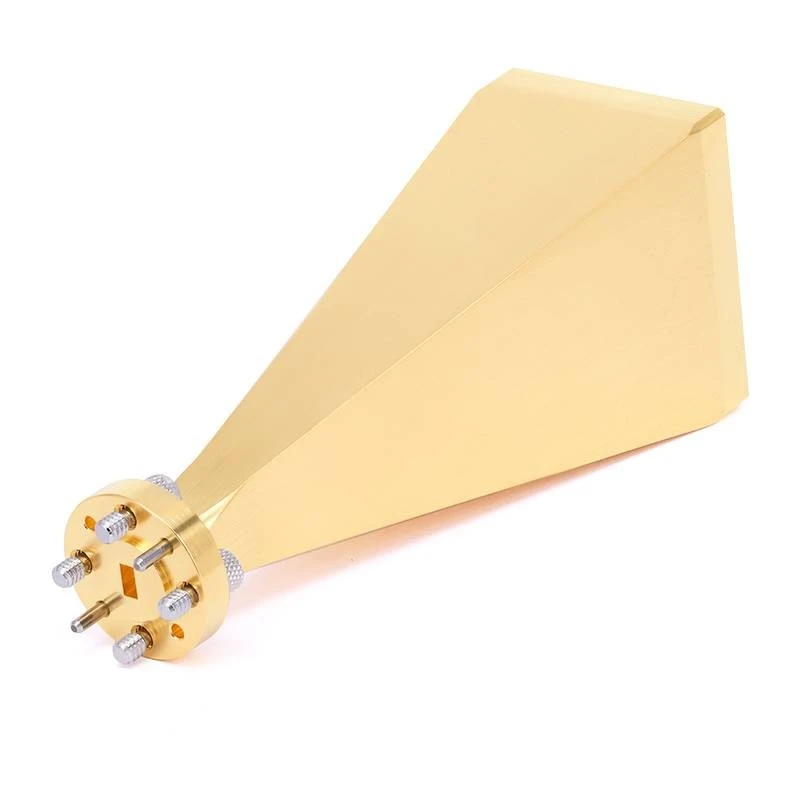
Horn antennas are a type of directional antenna that consists of a flared metal waveguide. They are widely used in microwave and millimeter-wave applications due to their high gain, low sidelobe levels, and wide bandwidth capabilities. Here are some of the advantages of using horn antennas in UWB communication:
Wide Bandwidth
One of the most significant advantages of horn antennas is their wide bandwidth. Horn antennas can operate over a broad frequency range, making them well-suited for UWB communication systems. By carefully designing the horn antenna's dimensions, it is possible to achieve a bandwidth of several gigahertz, which is essential for supporting the high data rates required by UWB applications.
High Gain
Horn antennas offer high gain, which means they can focus the radiated energy in a specific direction. This high gain allows horn antennas to transmit and receive signals over longer distances compared to omnidirectional antennas. In UWB communication systems, high gain antennas can improve the signal strength and range, resulting in better communication performance.
Low Sidelobe Levels
Horn antennas typically have low sidelobe levels, which means they radiate most of their energy in the main lobe and minimize the radiation in other directions. Low sidelobe levels are important in UWB communication systems to reduce interference and improve the signal-to-noise ratio. By minimizing the sidelobe radiation, horn antennas can enhance the overall performance of the UWB system.
Directional Radiation Pattern
The directional radiation pattern of horn antennas makes them suitable for applications where the signal needs to be focused in a specific direction. In UWB communication systems, directional antennas can be used to establish point-to-point links or to improve the signal strength in a particular area. By using horn antennas, it is possible to achieve better signal coverage and reduce the interference from other sources.
Limitations of Horn Antennas for UWB Communication
While horn antennas offer several advantages for UWB communication, they also have some limitations that need to be considered. Here are some of the limitations of using horn antennas in UWB systems:
Size and Weight
Horn antennas can be relatively large and heavy, especially at lower frequencies. The size and weight of horn antennas can make them difficult to integrate into small UWB devices or portable applications. In addition, the large size of horn antennas may limit their use in applications where space is limited.
Cost
Horn antennas can be more expensive compared to other types of antennas, such as dipole antennas or patch antennas. The cost of horn antennas is mainly due to the complex manufacturing process and the use of high-quality materials. In UWB communication systems, the cost of the antennas can be a significant factor, especially for large-scale deployments.
Limited Omnidirectional Coverage
The directional radiation pattern of horn antennas means that they have limited omnidirectional coverage. In applications where omnidirectional coverage is required, such as in wireless sensor networks or indoor positioning systems, horn antennas may not be the best choice. In these cases, omnidirectional antennas or a combination of directional and omnidirectional antennas may be more suitable.
Potential Applications of Horn Antennas in UWB Communication
Despite their limitations, horn antennas can be used in a variety of UWB communication applications. Here are some potential applications of horn antennas in UWB systems:
Wireless Personal Area Networks (WPANs)
Horn antennas can be used in WPANs to establish high-speed wireless links between devices. In WPANs, the high gain and wide bandwidth of horn antennas can improve the data transfer rate and the range of the communication. By using horn antennas, it is possible to achieve reliable and high-speed communication between devices such as smartphones, tablets, and laptops.
Indoor Positioning Systems
Horn antennas can be used in indoor positioning systems to improve the accuracy and reliability of the positioning. In indoor environments, the directional radiation pattern of horn antennas can be used to focus the signal in a specific area, reducing the interference from other sources. By using horn antennas, it is possible to achieve more accurate positioning and tracking of objects in indoor spaces.
Radar and Through-Wall Imaging
Horn antennas are widely used in radar and through-wall imaging applications due to their high gain and wide bandwidth capabilities. In radar systems, horn antennas can be used to transmit and receive the radar signals, allowing for the detection and tracking of objects. In through-wall imaging applications, horn antennas can be used to penetrate walls and detect the presence of objects behind them.
Conclusion
In conclusion, horn antennas can be used in UWB communication systems, offering several advantages such as wide bandwidth, high gain, low sidelobe levels, and directional radiation pattern. However, they also have some limitations, including size and weight, cost, and limited omnidirectional coverage. The suitability of horn antennas for UWB communication depends on the specific application requirements and the trade-offs between the advantages and limitations.
As a leading supplier of Horn Antennas, we are committed to providing high-quality antennas for UWB communication systems. Our horn antennas are designed to meet the demanding requirements of UWB applications, offering wide bandwidth, high gain, and low sidelobe levels. If you are interested in using horn antennas in your UWB communication system, please contact us to discuss your specific needs and requirements. We look forward to working with you to find the best antenna solution for your application.
References
- "Ultra-wideband Technology: Fundamentals and Applications" by Richard A. Scholtz, Luiz A. DaSilva, and Zhi Tian.
- "Antenna Theory: Analysis and Design" by Constantine A. Balanis.
- "Microwave Engineering" by David M. Pozar.


