

What types of horn antennas are there?
Leave a message

Hey there! As a supplier of Horn Antennas, I'm super stoked to dive into the different types of horn antennas out there. Horn antennas are pretty cool devices, and they've got a wide range of applications in the world of telecommunications, radar systems, and even in some scientific research. So, let's get right into it!
E-plane Horn Antennas
First up, we've got the E - plane horn antennas. These are named because the electric field (E - field) is the main focus here. The E - plane horn is basically a waveguide that's flared out in the direction of the electric field.
One of the key features of E - plane horn antennas is their relatively simple design. They're easy to manufacture, which makes them a cost - effective option for many applications. They're often used in situations where you need to have a relatively narrow beam in the E - plane. For example, in some microwave communication links, an E - plane horn can help direct the signal in a specific direction, reducing interference from other directions.
But they do have their limitations. The beamwidth in the H - plane (the plane perpendicular to the E - plane) is usually quite wide. So, if you need a more focused beam in both planes, an E - plane horn might not be the best choice. If you're interested in learning more about E - plane horn antennas and other types of Horn Antennas, feel free to check out our website.
H - plane Horn Antennas
Next, we have the H - plane horn antennas. Just like the E - plane horn, but this time, the waveguide is flared out in the direction of the magnetic field (H - field).
H - plane horn antennas are great for applications where you need a narrow beam in the H - plane. They can provide good directivity in that particular plane, which is useful in radar systems. For instance, in air traffic control radar, an H - plane horn can help detect aircraft more accurately by focusing the radar beam in the horizontal direction.
However, similar to E - plane horns, H - plane horns also have a wide beamwidth in the E - plane. So, if your application requires a more balanced beam pattern in both planes, you'll need to look elsewhere.
Pyramidal Horn Antennas
Now, pyramidal horn antennas are a bit of a hybrid. They're flared out in both the E - and H - planes, forming a pyramid - like shape. This design gives them a more balanced beam pattern compared to E - plane and H - plane horns.
Pyramidal horn antennas are very versatile. They can be used in a wide range of frequencies, from microwave to millimeter - wave frequencies. In wireless communication systems, pyramidal horns are often used as test antennas. They can accurately measure the performance of other antennas because of their well - defined radiation pattern.
Another advantage of pyramidal horn antennas is their relatively high gain. Gain is a measure of how well an antenna can focus the radio waves in a particular direction. A higher gain means the antenna can send and receive signals more effectively over longer distances. If you're in the market for a reliable, all - around antenna, pyramidal horn antennas are definitely worth considering.
Conical Horn Antennas
Conical horn antennas are shaped like a cone. They're different from the other types we've discussed so far because of their circular cross - section.
These antennas are great for applications that require a circularly symmetric radiation pattern. In satellite communication, for example, conical horn antennas can be used to send and receive signals to and from satellites. Their circular symmetry allows them to cover a wide range of angles in the azimuth plane, which is important when communicating with satellites that can be in different positions in the sky.
Conical horn antennas also have good impedance matching characteristics. This means that they can transfer power from the transmission line to the antenna more efficiently, reducing signal losses. If you're looking for an antenna with a circular radiation pattern, Horn Antennas like the conical ones on our website might be just what you need.
Sectoral Horn Antennas
Sectoral horn antennas are a variation of the basic horn antenna design. They're flared out in only one plane to a greater extent than the other, creating a sector - shaped radiation pattern.
There are two types of sectoral horn antennas: E - sectoral and H - sectoral. E - sectoral horns are flared more in the E - plane, while H - sectoral horns are flared more in the H - plane. These antennas are useful in applications where you need to cover a specific sector or area. For example, in a security surveillance system, a sectoral horn antenna can be used to monitor a particular area, like a parking lot or a building entrance.
Corrugated Horn Antennas
Corrugated horn antennas are a bit more advanced. They have small grooves or corrugations on the inside of the horn. These corrugations help to improve the antenna's performance in several ways.
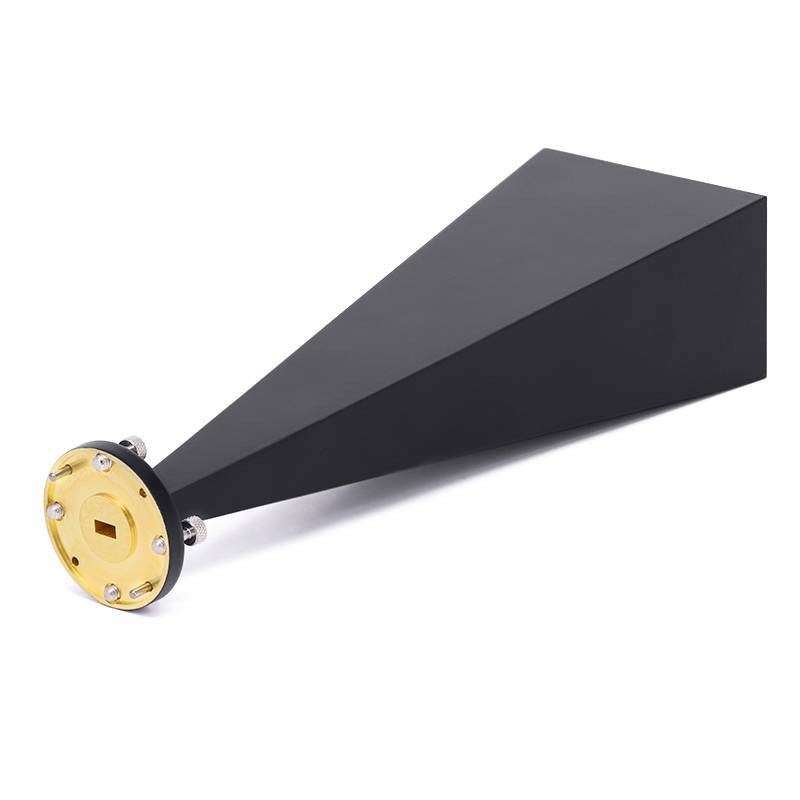

One of the main benefits of corrugated horn antennas is their low cross - polarization. Cross - polarization can cause interference in some applications, especially in satellite communication. By reducing cross - polarization, corrugated horn antennas can provide a cleaner signal.
They also have a more symmetric radiation pattern compared to non - corrugated horns. This makes them ideal for applications where a precise and balanced radiation pattern is required, such as in radio astronomy. Radio astronomers use corrugated horn antennas to detect weak signals from distant celestial objects.
Log - periodic Horn Antennas
Last but not least, we have the Log - periodic Antennas. These antennas have a unique design where the size and spacing of the elements change logarithmically.
Log - periodic horn antennas are known for their wide bandwidth. They can operate over a large range of frequencies without significant changes in their performance. This makes them great for applications where you need to cover multiple frequency bands, like in some military communication systems.
They also have a relatively stable radiation pattern over their operating frequency range. So, whether you're using them at a low frequency or a high frequency, you can expect consistent performance.
Why Choose Our Horn Antennas?
As a supplier of horn antennas, we take pride in offering high - quality products. Our horn antennas are designed and manufactured using the latest technology and the best materials. We've got a wide range of horn antennas, from the basic E - plane and H - plane horns to the more advanced corrugated and log - periodic horns.
We understand that different applications have different requirements. That's why we offer customization options. If you need a horn antenna with specific dimensions, gain, or radiation pattern, we can work with you to create a solution that meets your needs.
Our team of experts is always ready to help you choose the right antenna for your application. Whether you're a small business owner looking for an antenna for your wireless network or a large corporation working on a complex radar system, we've got you covered.
Let's Talk!
If you're interested in purchasing horn antennas for your project, we'd love to hear from you. We can provide you with detailed product information, pricing, and delivery options. Just reach out to us, and we'll start the conversation about how we can meet your antenna needs. Whether it's a single antenna or a large - scale order, we're committed to providing you with the best service and the highest - quality products.
References
- Balanis, Constantine A. "Antenna Theory: Analysis and Design." Wiley, 2016.
- Stutzman, Warren L., and Gary A. Thiele. "Antenna Theory and Design." Wiley, 2012.


