

How does an RF adapter work in satellite communication?
Leave a message

Hey there! As a supplier of RF adapters, I often get asked about how these little gadgets work, especially in the context of satellite communication. So, I thought I'd take a moment to break it down for you in a way that's easy to understand.
Let's start with the basics. RF, or radio frequency, is a type of electromagnetic wave that's used for a whole bunch of things, from your cell phone to satellite communication. RF adapters are devices that help connect different types of RF connectors. Think of them as the translators of the RF world, allowing different components to "talk" to each other.
In satellite communication, RF adapters play a crucial role. Satellites are like the messengers in the sky, sending and receiving signals to and from Earth. These signals are in the form of RF waves, and they need to be transmitted and received accurately. That's where RF adapters come in.
How RF Signals are Generated and Transmitted in Satellite Communication
First off, let's talk about how RF signals are generated and transmitted in satellite communication. On Earth, we have ground stations that are responsible for sending signals up to the satellites. These ground stations use transmitters to generate RF signals at specific frequencies.
The generated RF signals are then sent through a series of cables and connectors. This is where RF adapters can be really useful. For example, if the output connector of the transmitter is different from the input connector of the cable, an RF adapter can be used to make the connection.
Let's say you have a transmitter with a 1.0mm Adapter output, but the cable you want to use has a different type of connector. You can use an appropriate RF adapter to bridge the gap and ensure that the RF signal can be transmitted smoothly from the transmitter to the cable.
Once the RF signal reaches the end of the cable on the ground station, it's sent up to the satellite through an antenna. The satellite then receives the signal, processes it, and re - transmits it back to Earth to other ground stations or end - users.
The Role of RF Adapters in Signal Reception
On the receiving end, the process is a bit similar but in reverse. The satellite sends the RF signals back to Earth, and the ground stations' antennas pick up these signals. The antennas are connected to receivers through cables and connectors.
Again, RF adapters might be needed here. Suppose the antenna has a 3.5mm Adapter connector, but the input of the receiver has a different type. An RF adapter can be used to connect the antenna to the receiver properly.
The receiver then decodes the RF signals and converts them into usable information, like TV signals, internet data, or phone calls.
Technical Aspects of RF Adapters in Satellite Communication
Now, let's get into a bit more technical stuff. RF adapters need to have certain characteristics to work well in satellite communication. One of the most important things is impedance matching.
Impedance is like the resistance that an RF signal encounters as it travels through a circuit. In satellite communication, it's crucial that the impedance of the source (like a transmitter), the adapter, and the load (like a cable or receiver) are all matched. If the impedance is not matched, a part of the RF signal can be reflected back, which can lead to signal loss and degradation.
Good RF adapters are designed to have a specific impedance, usually 50 ohms, which is a standard in most RF applications, including satellite communication. This helps to ensure that the RF signal can pass through the adapter with minimal loss.
Another important aspect is the frequency range. Satellite communication uses different frequency bands, such as C - band, Ku - band, and Ka - band. RF adapters need to be able to work effectively within these frequency ranges.
For example, if you're using an adapter in a Ka - band satellite communication system, it needs to be able to handle the high - frequency signals in that band without introducing too much attenuation (weakening of the signal).
Types of RF Adapters Used in Satellite Communication
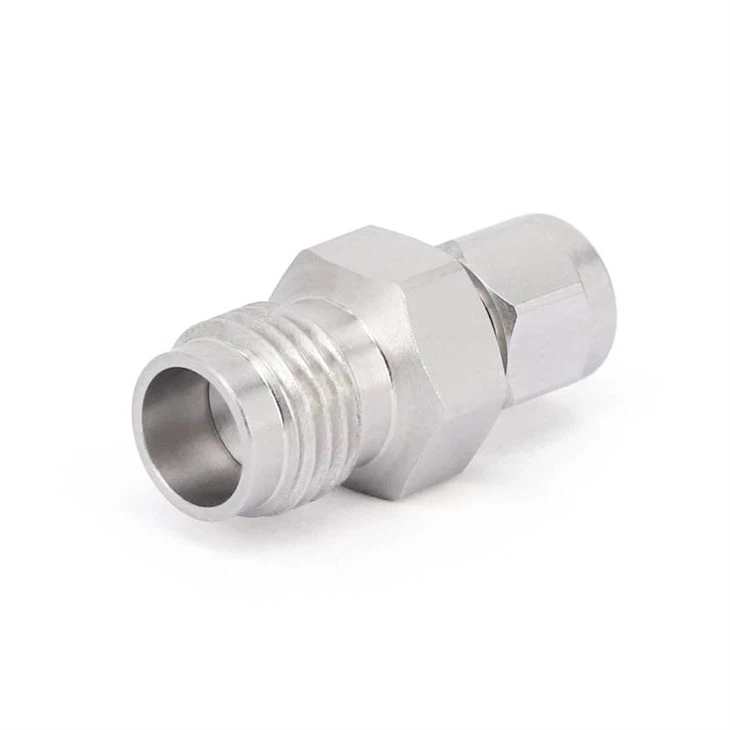
There are several types of RF adapters commonly used in satellite communication. One of the popular ones is the N Adapter. The N - type connector is known for its durability and ability to handle high - power RF signals. It's often used in the connection between antennas and receivers or transmitters in satellite ground stations.
BNC (Bayonet Neill - Concelman) adapters are also used, especially in lower - power and lower - frequency applications. They are easy to connect and disconnect, which can be handy for testing and maintenance in satellite communication systems.
SMA (Sub - Miniature version A) adapters are another type. They are small in size and are often used in applications where space is limited, such as in some satellite - mounted equipment.

Quality and Reliability of RF Adapters
In satellite communication, the quality and reliability of RF adapters are of utmost importance. A faulty adapter can cause a lot of problems, such as signal interference, loss, or even complete system failure.
That's why, as a supplier, we pay a lot of attention to the manufacturing process of our RF adapters. We use high - quality materials to ensure good electrical conductivity and mechanical stability. Our adapters are also tested rigorously to make sure they meet the required standards for satellite communication.
Conclusion and Call to Action
So, there you have it - a basic overview of how RF adapters work in satellite communication. They might seem like small components, but they play a huge role in ensuring that satellite - based communication systems work smoothly.
If you're in the business of satellite communication or any other RF - related field and are looking for high - quality RF adapters, we'd love to hear from you. Whether you need 1.0mm Adapter, 3.5mm Adapter, N Adapter, or any other type of RF adapter, we've got you covered. Reach out to us to start a conversation about your specific requirements and let's work together to find the best solutions for your needs.
References
- Pozar, D. M. (2011). Microwave Engineering. Wiley.
- Collin, R. E. (2001). Foundations for Microwave Engineering. Wiley - Interscience.


