
What are the common performance parameters of VNA test cables?
Leave a message

Hey there! As a supplier of VNA Test Cables, I often get asked about the common performance parameters of these cables. In this blog post, I'll break down the key aspects that you should know when it comes to VNA test cables.
1. Insertion Loss
Insertion loss is one of the most crucial performance parameters of VNA test cables. It basically measures the amount of signal power that is lost as the signal travels through the cable. You can think of it as how much of the original signal strength gets "eaten up" by the cable itself.
Low insertion loss is always desirable because it means that more of the signal reaches the destination without being weakened. For high - frequency applications, even a small increase in insertion loss can have a significant impact on the accuracy of the measurements. The insertion loss of a cable is usually expressed in decibels (dB) and is frequency - dependent. As the frequency goes up, the insertion loss generally increases. This is due to factors like conductor resistance, dielectric losses, and radiation losses.
When choosing VNA test cables, you want to look for cables with low insertion loss specifications, especially if you're working with high - frequency signals. For example, in some applications where you're dealing with frequencies in the GHz range, a cable with an insertion loss of less than 1 dB per meter at a specific frequency might be ideal.
2. Return Loss
Return loss is another important parameter. It measures the amount of signal that is reflected back from the cable. When a signal travels through a cable, any impedance mismatches can cause part of the signal to bounce back towards the source. This reflected signal can interfere with the original signal and cause measurement errors.
A high return loss value is good because it indicates that very little of the signal is being reflected. Return loss is also expressed in decibels (dB). A cable with a return loss of 20 dB or more is considered to have good performance. You can use Calibration Kits to help reduce the effects of impedance mismatches and improve the return loss of your VNA test cables.
3. VSWR (Voltage Standing Wave Ratio)
VSWR is closely related to return loss. It is a measure of how well the cable is matched to the load and the source. VSWR is the ratio of the maximum voltage to the minimum voltage along the cable. A VSWR of 1:1 is ideal, which means there is a perfect match and no signal reflection. However, in real - world applications, achieving a perfect match is almost impossible.
In general, a VSWR of less than 1.5:1 is considered good for most VNA test cable applications. A high VSWR can lead to increased insertion loss and reduced power transfer efficiency. So, when you're evaluating VNA test cables, pay attention to the VSWR specification.
4. Phase Stability
Phase stability is critical, especially in applications where the phase of the signal is important, such as in phased - array antennas or some types of RF measurements. Phase stability refers to how much the phase of the signal changes over time, temperature, and mechanical flexing.
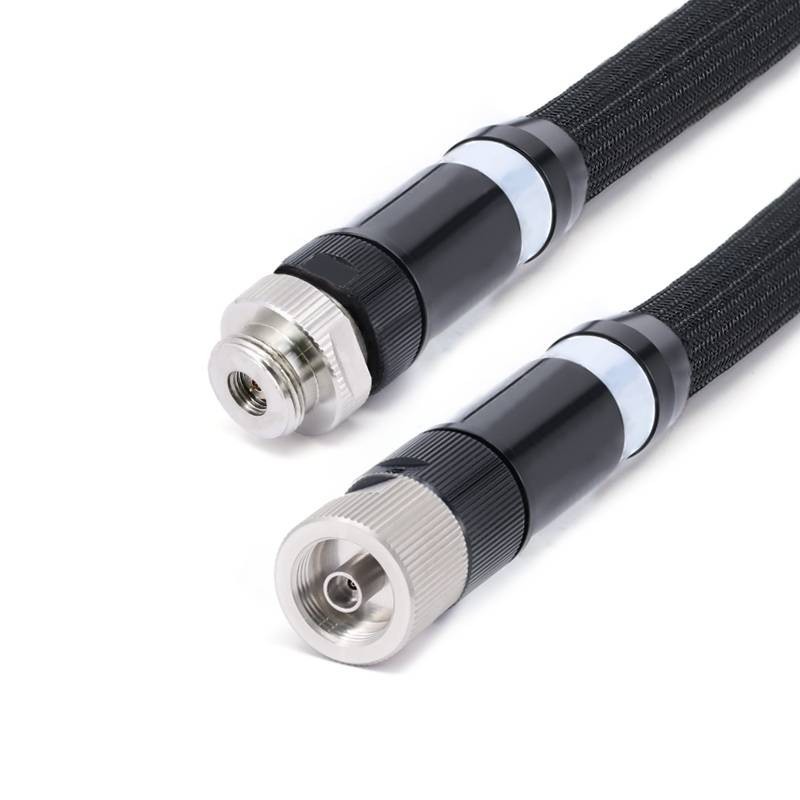

A cable with good phase stability will have minimal phase variations under different conditions. For example, if you're using a VNA test cable in an environment where the temperature can vary widely, you need a cable that can maintain a stable phase. Phase stability is usually specified in degrees per degree Celsius (°/°C) or degrees per flex cycle.
5. Amplitude Stability
Similar to phase stability, amplitude stability is about how much the amplitude of the signal changes over time, temperature, and mechanical stress. A cable with good amplitude stability will have consistent signal strength under different conditions.
Temperature changes can cause the cable's electrical properties to change, which in turn can affect the amplitude of the signal. Mechanical flexing can also cause the cable to stretch or compress, leading to amplitude variations. You want a VNA test cable with low amplitude variation, especially if you need accurate and repeatable measurements.
6. Frequency Range
The frequency range of a VNA test cable indicates the range of frequencies over which the cable can operate effectively. Different applications require different frequency ranges. For example, some low - frequency applications might only need a cable that can operate up to a few hundred MHz, while high - frequency applications in the microwave or millimeter - wave range might require cables that can handle frequencies up to 40 GHz or more.
When choosing a VNA test cable, make sure the frequency range of the cable matches your application requirements. Using a cable outside of its specified frequency range can lead to poor performance, including high insertion loss and inaccurate measurements.
7. Flex Life
Flex life is an important consideration, especially if your VNA test cables will be moved or bent frequently. Flex life refers to the number of times a cable can be bent or flexed before its performance starts to degrade.
Cables with a high flex life are more durable and can withstand repeated bending without significant changes in their electrical properties. For example, if you're using a VNA test cable in a test setup where the cable needs to be moved around a lot, you'll want a cable with a high flex life rating, such as 10,000 or more flex cycles.
8. Temperature Range
The temperature range of a VNA test cable specifies the range of temperatures within which the cable can operate safely and maintain its performance. Extreme temperatures can have a significant impact on the electrical and mechanical properties of the cable.
In cold temperatures, the cable's dielectric material might become more brittle, which can lead to cracking or increased signal loss. In hot temperatures, the cable's insulation might degrade, causing short - circuits or other problems. Make sure to choose a VNA test cable with a temperature range that suits your operating environment.
Why Choose Our VNA Test Cables?
At our company, we understand the importance of these performance parameters. Our VNA Test Cables are designed and manufactured to meet the highest standards. We use high - quality materials and advanced manufacturing processes to ensure low insertion loss, high return loss, excellent phase and amplitude stability, and long flex life.
Whether you're working on a small - scale RF project or a large - scale industrial application, our VNA test cables can provide accurate and reliable measurements. We also offer a wide range of cables with different frequency ranges and temperature ratings to suit your specific needs.
If you're in the market for VNA test cables, we'd love to talk to you. Our team of experts can help you choose the right cables for your application and answer any questions you might have. So, don't hesitate to reach out and start a conversation about your VNA test cable requirements. We're here to make sure you get the best cables for your money and achieve the most accurate measurements possible.
References
- "RF and Microwave Transmission Line Design Handbook" by George L. Matthaei, Leo Young, and E. M. T. Jones.
- "Antenna Theory: Analysis and Design" by Constantine A. Balanis.


