
What are the different types of antennas?
Leave a message

Antennas are essential components in modern communication systems, serving as the interface between electrical circuits and electromagnetic waves. As an antennas supplier, I've witnessed firsthand the diverse range of antennas available in the market, each designed for specific applications and operating conditions. In this blog post, I'll explore the different types of antennas, their characteristics, and typical use cases.
Dipole Antennas
Dipole antennas are one of the simplest and most widely used types of antennas. They consist of two conductive elements, typically rods or wires, that are fed at the center. Dipole antennas are omnidirectional in the plane perpendicular to the antenna axis, meaning they radiate and receive signals equally well in all directions within that plane.
One of the key advantages of dipole antennas is their simplicity and low cost. They are relatively easy to design and manufacture, making them a popular choice for a variety of applications, including radio broadcasting, wireless communication, and radar systems. Dipole antennas can be designed to operate at different frequencies by adjusting the length of the conductive elements.
However, dipole antennas also have some limitations. Their radiation pattern is not very directional, which means they may not be suitable for applications where high gain or focused radiation is required. Additionally, dipole antennas are sensitive to the surrounding environment, and their performance can be affected by nearby objects or interference.
Monopole Antennas
Monopole antennas are similar to dipole antennas, but they consist of a single conductive element that is mounted above a ground plane. The ground plane acts as a mirror, effectively doubling the length of the antenna and creating a radiation pattern that is similar to that of a dipole antenna.
Monopole antennas are commonly used in mobile devices, such as smartphones and tablets, as well as in wireless access points and other small wireless devices. They are compact and easy to integrate into small form factors, making them a popular choice for applications where space is limited.
Like dipole antennas, monopole antennas are omnidirectional in the plane perpendicular to the antenna axis. However, they have a higher gain in the vertical direction, which makes them more suitable for applications where signals need to be transmitted or received in a specific direction.
Loop Antennas
Loop antennas consist of a conductive loop that is connected to a feed point. The loop can be circular, square, or rectangular in shape, and it can be either a single turn or multiple turns. Loop antennas can be classified into two main types: small loop antennas and large loop antennas.
Small loop antennas, also known as magnetic loop antennas, are typically less than one-tenth of a wavelength in circumference. They are highly directional and have a low radiation resistance, which makes them suitable for applications where high sensitivity and low noise are required, such as in radio receivers and magnetic field sensors.
Large loop antennas, on the other hand, are typically more than one wavelength in circumference. They have a more omnidirectional radiation pattern and a higher radiation resistance, which makes them suitable for applications where high power and wide coverage are required, such as in radio transmitters and wireless communication systems.
Horn Antennas
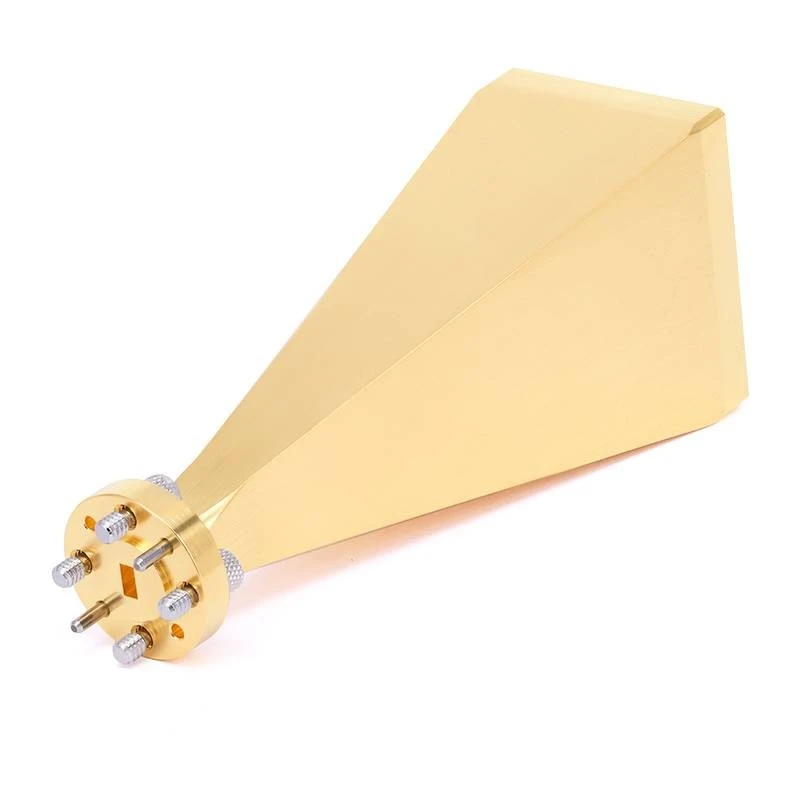
Horn Antennas are a type of aperture antenna that consists of a flared waveguide that gradually expands into a horn-shaped opening. Horn antennas are highly directional and have a high gain, which makes them suitable for applications where long-range communication or high-resolution imaging is required, such as in radar systems, satellite communication, and radio astronomy.
One of the key advantages of horn antennas is their wide bandwidth and low loss. They can operate over a wide range of frequencies, making them suitable for applications where multiple frequencies need to be supported. Additionally, horn antennas are relatively easy to design and manufacture, and they can be made in a variety of shapes and sizes to meet specific application requirements.
However, horn antennas also have some limitations. They are relatively large and bulky, which makes them less suitable for applications where space is limited. Additionally, horn antennas are sensitive to the surrounding environment, and their performance can be affected by nearby objects or interference.
Log-periodic Antennas
Log-periodic Antennas are a type of antenna that has a frequency-independent radiation pattern. They consist of a series of dipole elements that are arranged in a logarithmic pattern, with the length and spacing of the elements increasing logarithmically from the feed point.
Log-periodic antennas are commonly used in applications where a wide bandwidth and high gain are required, such as in television and radio broadcasting, wireless communication, and radar systems. They are able to operate over a wide range of frequencies, making them suitable for applications where multiple frequencies need to be supported.
One of the key advantages of log-periodic antennas is their wide bandwidth and high gain. They are able to provide a consistent radiation pattern over a wide range of frequencies, which makes them suitable for applications where frequency agility is required. Additionally, log-periodic antennas are relatively easy to design and manufacture, and they can be made in a variety of shapes and sizes to meet specific application requirements.
However, log-periodic antennas also have some limitations. They are relatively large and bulky, which makes them less suitable for applications where space is limited. Additionally, log-periodic antennas are sensitive to the surrounding environment, and their performance can be affected by nearby objects or interference.
Yagi-Uda Antennas
Yagi-Uda antennas, also known as Yagi antennas, are a type of directional antenna that consists of a driven element, one or more reflectors, and one or more directors. The driven element is typically a dipole antenna that is connected to the feed point, while the reflectors and directors are parasitic elements that are not connected to the feed point.
Yagi-Uda antennas are commonly used in applications where high gain and directional radiation are required, such as in television and radio broadcasting, wireless communication, and radar systems. They are able to provide a highly directional radiation pattern, which makes them suitable for applications where long-range communication or high-resolution imaging is required.
One of the key advantages of Yagi-Uda antennas is their high gain and directional radiation pattern. They are able to provide a significant increase in signal strength in the direction of the main lobe, which makes them suitable for applications where long-range communication or high-resolution imaging is required. Additionally, Yagi-Uda antennas are relatively easy to design and manufacture, and they can be made in a variety of shapes and sizes to meet specific application requirements.
However, Yagi-Uda antennas also have some limitations. They are relatively narrowband, which means they are only able to operate over a limited range of frequencies. Additionally, Yagi-Uda antennas are sensitive to the surrounding environment, and their performance can be affected by nearby objects or interference.
Parabolic Antennas
Parabolic antennas are a type of reflector antenna that consists of a parabolic reflector and a feed antenna. The parabolic reflector is a curved surface that is shaped like a parabola, and it is used to focus the electromagnetic waves onto the feed antenna.
Parabolic antennas are commonly used in applications where high gain and directional radiation are required, such as in satellite communication, radar systems, and radio astronomy. They are able to provide a highly directional radiation pattern, which makes them suitable for applications where long-range communication or high-resolution imaging is required.
One of the key advantages of parabolic antennas is their high gain and directional radiation pattern. They are able to provide a significant increase in signal strength in the direction of the main lobe, which makes them suitable for applications where long-range communication or high-resolution imaging is required. Additionally, parabolic antennas are relatively easy to design and manufacture, and they can be made in a variety of shapes and sizes to meet specific application requirements.
However, parabolic antennas also have some limitations. They are relatively large and bulky, which makes them less suitable for applications where space is limited. Additionally, parabolic antennas are sensitive to the surrounding environment, and their performance can be affected by nearby objects or interference.

Conclusion
In conclusion, there are many different types of antennas available in the market, each designed for specific applications and operating conditions. As an antennas supplier, I understand the importance of choosing the right antenna for your application. Whether you need a high-gain directional antenna for long-range communication or a wideband omnidirectional antenna for wireless networking, I can help you find the perfect solution.
If you're interested in learning more about our antennas or would like to discuss your specific requirements, please don't hesitate to contact us. Our team of experts is always available to answer your questions and provide you with the information you need to make an informed decision. We look forward to working with you!
References
- Balanis, C. A. (2016). Antenna Theory: Analysis and Design. Wiley.
- Kraus, J. D., & Marhefka, R. J. (2002). Antennas for All Applications. McGraw-Hill.
- Stutzman, W. L., & Thiele, G. A. (2012). Antenna Theory and Design. Wiley.


