
What is the difference between coaxial and waveguide RF switches?
Leave a message

In the realm of radio frequency (RF) technology, switches play a crucial role in managing signal routing and distribution. Two commonly used types of RF switches are coaxial and waveguide switches. As an established RF switches supplier, I've witnessed firsthand the unique characteristics and applications of both these technologies. In this blog post, I'll delve into the differences between coaxial and waveguide RF switches, helping you understand which one is best suited for your specific needs.
1. Basic Structure and Working Principle
Coaxial RF Switches
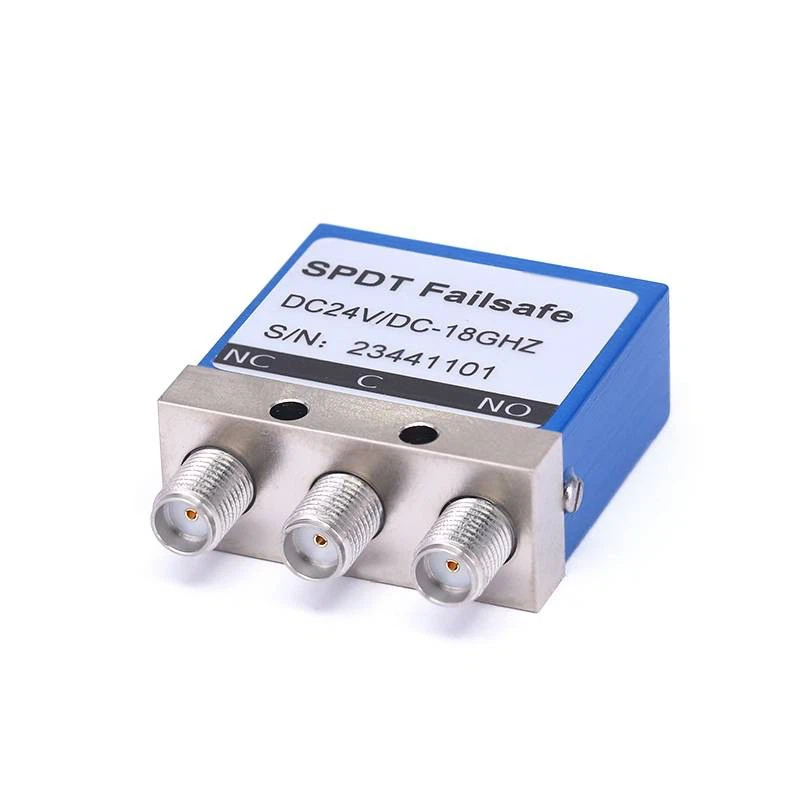
Coaxial RF switches are built around coaxial cables, which consist of a central conductor, an insulating layer, an outer conductor, and an outer protective jacket. The central conductor carries the RF signal, while the outer conductor acts as a shield, minimizing electromagnetic interference. These switches operate by mechanically or electronically altering the connection between different coaxial ports.
Mechanically - actuated coaxial switches use physical movement, such as a solenoid or a motor, to change the signal path. Electronic coaxial switches, on the other hand, rely on semiconductor devices like PIN diodes or field - effect transistors (FETs) to control the signal flow. This allows for faster switching speeds and a longer operational lifespan compared to mechanical switches.
Waveguide RF Switches
Waveguide RF switches are based on waveguides, which are hollow metal tubes that guide electromagnetic waves. Unlike coaxial cables, waveguides do not have a central conductor. Instead, they use the internal walls of the tube to confine and direct the RF energy.
Waveguide switches typically use mechanical means to change the signal path. For example, a movable short - circuiting plunger or a rotating vane can be used to redirect the RF wave within the waveguide. This mechanical operation is often more complex than that of coaxial switches due to the need to precisely control the wave propagation within the waveguide structure.
2. Performance Characteristics
Frequency Range
One of the most significant differences between coaxial and waveguide RF switches lies in their frequency ranges. Coaxial RF switches are generally suitable for a wide range of frequencies, from a few kilohertz up to several gigahertz. This wide frequency coverage makes them versatile for various applications, including wireless communication systems, test and measurement equipment, and radar systems.
Waveguide RF switches, on the other hand, are more commonly used at higher frequencies, typically starting from around 1 GHz and going up to several hundred gigahertz. At these high frequencies, waveguides offer lower loss and better performance compared to coaxial cables. For applications such as millimeter - wave communication, satellite communication, and high - frequency radar, waveguide switches are often the preferred choice.
Insertion Loss
Insertion loss refers to the amount of signal power that is lost when passing through the switch. Coaxial RF switches typically have relatively higher insertion loss compared to waveguide switches, especially at higher frequencies. This is because the central conductor in coaxial cables introduces additional resistance and dielectric losses.
Waveguide switches, due to their structure and the way they guide electromagnetic waves, generally have lower insertion loss at high frequencies. The absence of a central conductor reduces the sources of loss, allowing for more efficient signal transmission.
Isolation
Isolation is a measure of how well the switch can prevent signal leakage between different ports. Waveguide RF switches usually offer better isolation than coaxial switches. The enclosed nature of waveguides helps to contain the RF energy within the desired path, minimizing cross - talk between ports.
Coaxial switches, while they can achieve good isolation, may be more susceptible to electromagnetic coupling between adjacent ports, especially at high frequencies or in densely packed systems.
Power Handling Capacity
Waveguide RF switches generally have a higher power handling capacity than coaxial switches. The large cross - sectional area of waveguides allows them to handle higher levels of RF power without overheating or suffering from excessive signal distortion. This makes waveguide switches suitable for high - power applications such as high - power radar transmitters and high - power communication amplifiers.
Coaxial switches, while they can handle a reasonable amount of power, are more limited in their power - handling capabilities, especially at higher frequencies. The small size of coaxial cables and the presence of a central conductor can lead to higher power dissipation and potential breakdown at high power levels.
3. Size and Form Factor
Coaxial RF Switches
Coaxial RF switches are relatively compact and lightweight. Their design is based on coaxial cables, which are available in various diameters and lengths. This allows for a wide range of form factors, from small surface - mount devices suitable for printed circuit boards to larger rack - mountable units for test and measurement applications.
The compact size of coaxial switches makes them ideal for applications where space is limited, such as mobile devices, portable test equipment, and small - scale communication systems.
Waveguide RF Switches
Waveguide RF switches are generally larger and heavier than coaxial switches. The size of waveguides is determined by the operating frequency, with lower frequencies requiring larger cross - sectional areas. This results in bulkier and more massive switch designs.
The large size of waveguide switches can be a limitation in applications where space is at a premium. However, in applications where high - frequency performance and power handling are critical, the larger size is often an acceptable trade - off.
4. Cost
Coaxial RF Switches
Coaxial RF switches are generally more cost - effective than waveguide switches. The manufacturing process for coaxial cables and the associated switch components is well - established and relatively simple, resulting in lower production costs.
Additionally, the wide availability of coaxial components in the market further drives down the cost. This makes coaxial switches a popular choice for cost - sensitive applications, especially those with lower frequency requirements.
Waveguide RF Switches
Waveguide RF switches are more expensive due to their complex manufacturing process and the need for precise machining. The production of waveguides requires high - precision manufacturing techniques to ensure proper wave propagation and performance.
The higher cost of waveguide switches makes them less suitable for applications with strict cost constraints but is often justified in high - performance, high - frequency applications where their unique characteristics are essential.
5. Applications
Coaxial RF Switches
Coaxial RF switches find applications in a wide range of industries. In the telecommunications industry, they are used in cellular base stations, wireless access points, and microwave backhaul systems. In the test and measurement field, coaxial switches are essential for signal routing in network analyzers, spectrum analyzers, and other test equipment. They are also commonly used in consumer electronics, such as mobile phones and Wi - Fi routers. For more information on different types of RF switches, you can visit RF Switches Types.

Waveguide RF Switches
Waveguide RF switches are mainly used in high - frequency and high - power applications. In the aerospace and defense industry, they are used in radar systems, satellite communication terminals, and electronic warfare equipment. In the research and development field, waveguide switches are used in millimeter - wave and terahertz research. They are also employed in high - power microwave systems, such as particle accelerators and industrial heating applications.
Conclusion
In summary, coaxial and waveguide RF switches have distinct differences in their structure, performance, size, cost, and applications. Coaxial switches offer versatility, compactness, and cost - effectiveness, making them suitable for a wide range of applications, especially those with lower frequency requirements. Waveguide switches, on the other hand, provide superior performance at high frequencies and high power levels, despite their larger size and higher cost.
As an RF switches supplier, I understand that choosing the right switch for your application is crucial. Whether you need a coaxial switch for a cost - sensitive, low - frequency application or a waveguide switch for a high - performance, high - frequency system, I can provide you with the expertise and products to meet your needs. If you're interested in learning more about our RF switches or would like to discuss a specific application, I encourage you to contact me for a detailed consultation and to start the procurement process.
References
- Pozar, D. M. (2011). Microwave Engineering (4th ed.). Wiley.
- Collin, R. E. (2001). Foundations for Microwave Engineering (2nd ed.). McGraw - Hill.
- Matthaei, G. L., Young, L., & Jones, E. M. T. (1964). Microwave Filters, Impedance - Matching Networks, and Coupling Structures. McGraw - Hill.


